|
Stephen
Barber & Sandi Harris Lutemakers |
|
Catalogue
and Price List 2017 |
 |
|
Instruments available for sale now This page last updated on Monday 7th August 2017 Now trending, as it were . . . We wrote here previously about the devastating fire that struck our workshop in June 2014; we'd like to reassure you that we are still in business and operating, albeit at a slower pace than before; here's a brief account of how things have panned out and evolved: In the aftermath of the fire, we were grateful to have received many messages and offers of help, as well as very practical assistance in clearing-up and making-good, from several friends and colleagues, among whom we'd particularly like to thank Lynda Sayce, the well-known theorbo player, expert and scholar, who interrupted a busy work schedule – twice – to spend time helping us here; and also Patrick van der Valk, who drove over from Utrecht to spend a long weekend helping us; he's now an expert in cleaning metal tools corroded by fire extinguisher chemicals, as well as being a computer systems expert. After the best part of six months unable to work properly, we were finally able to get going again. It appears, however, to be the case that several people have wondered if we'd ceased working, or closed-down in the aftermath of the fire; the website having not been updated since March 2016 seems to have added to speculation. What actually happened, according to medical opinion based on numerous tests and evaluations including MRI and CT scans, is that as a result of fighting the fire, surrounded by dense black smoke (the nearby windows couldn't be seen a metre away on a bright sunny day), Steve seems to have inhaled various toxins, which may have caused a severe ongoing balance problem; and a diagnosis of PTSD – triggered by the extreme experience and trauma of 'fight-or-flight' where defeating the furiously-burning fire was concerned . So we had to 're-boot', taking Steve's changed health situation into account. We decided to concentrate on getting up-and-running again, while we worked out how best Steve could adapt, and develop new approaches and methods, given his current ongoing health condition; we're working more slowly, but every instrument we've made since we got started again has been as good as anything we ever made before the fire, and all have been very well-received, from Portland, Oregon to Chattanooga, Tennessee and from Antwerp to Cambridge. You can order with complete confidence, as before. Please read on; we hope you enjoy browsing through our site. Welcome to the page of our website which lists instruments that we build 'on spec' to offer for immediate sale; we apologise for not having been in a position to update this page regularly for much of 2016 and into 2017: the background to this is outlined above. Following the devastating fire and its ramifications, we lost a huge amount of working time, and were unable to continue work on any of the instruments offered for sale here, we had perforce to concentrate on existing orders, and focus our efforts on trying to get back up to speed; Steve's health setbacks haven't exactly helped. Other instruments which had been offered for sale here below in 2014 have in fact been sold, pre-reserved – and / or were built during 2014 and early 2015. We plan to have finished as soon as is feasible in 2017–2018 these 'on spec' instruments: a 7-course g' lute (see below), an 8-course lute in f#, a 10c lute in f# and a 13c baroque lute. Please check this page regularly if you are interested in acquiring one of the instruments listed here, without going on our waiting-list, because it is updated as new instruments are planned, become available, or are sold. Business Facebook Page: Neither of us has a personal Facebook page, however, we launched a Business Facebook page in early September 2014, and we've since been trying to regularly add images and descriptions of current and new work, as well as images of work in progress, us working, and short movies, which people have often requested: www.Facebook.com/BarberAndHarris There are already links to short movies that have been made about our workshop, and the Yards where we work in general. The new Facebook page will complement our main website page, and we will be able to keep it regularly updated, fresh and interesting. 5-course French Baroque Guitar One available now, the next one underway; planned completion timeframe: November / December 2017
£5600 We managed to finish another example of this popular guitar, just before travelling to the Regensburg Tage Alter Musik festival in late May; please feel free to get in touch if you are interested in buying it. 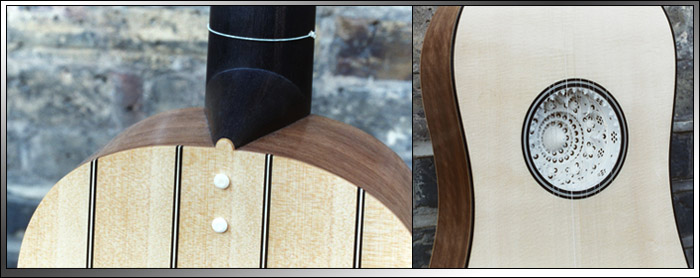
Five-piece back of beautiful, fine-grained quarter-sawn Italian cypress (see images below) with black/white/black (ebony/holly/ebony) stripes in between; figured walnut sides; ebony-veneered neck and pegbox; ebony pegs with bone pips; classic Voboam 4-tiered parchment rosette. The original instrument has the distinctive black & white 'Voboam' chevron decoration around its belly and along its neck; however, for this guitar, we've adopted the style and detailing of other surviving, plainer guitars by Alexandre Voboam (the 1690 double guitar in the Vienna KHM and another guitar dated 1652) neither of which have the black & white chevron decoration. This keeps the construction and materials costs of this model down, whilst producing a guitar which is historically correct in terms of its design, construction and aesthetics. It's quite clear from a few surviving plainer yet very elegant models that the Voboam dynasty built working, 'everyday' instruments for professional players, as well as the highly-decorated guitars for wealthier players for which they are more famous. A 'classic' French flat-back guitar, with a very clear and full sound, excellent for both solo and continuo playing; very similar to the guitar shown here, using the same materials and detailing. A fairly recent version of this guitar was made for Negin Habibi, the Hannover-based Persian classical guitarist, who collected her instrument at the Regensburg Tage Alter Musik festival in June 2012. She wrote: "Hello Stephen, I want to thank you and Sandi very much for this beautiful guitar. I'm very motivated to learn how to play it. Greetings from Frank Bungarten. Best Regards, Negin". Another interesting example went to Barcelona player Martí Beltran Gonzalez, who emailed this message to us in mid-December 2010: "Hi Stephen and Sandi, Thanks for the strings and for the guitar. The guitar is growing and it has no limits. It's a lot of money but it's a great instrument and I'm very happy with it. Thanks for all and a very happy Christmas and a New Year. Best luck in 2011, Mart’". Currently
our most sought-after baroque guitar: Stephen Stubbs, Andrew Maginley
and Radamés Paz are among owners of this model who use it constantly
– it's a guitar that more than earns its keep. They've all commented
it's the best baroque guitar they have ever played. It works extremely
well with gut stringing, we recommend Nicholas Baldock's excellent Kathedrale gut strings.
Further down this page, there is a detailed list of planned instruments and instruments under construction and in progress, which are available – or will soon be available to buy – along with their prices and proposed completion dates. We currently have four instruments underway: a 7c in g', an 8c lute in f#', a 10c lute in f# and a 13-course baroque lute, with another Voboam guiter – as above – planned for the end of 2017. 10-course
lute 11-rib back from highly-figured ash; ebony fingerboard with inlaid white panel line; ebony-veneered neck and pegbox, pegbox cheeks veneered with snakewood, with bone edgings; ebony pegs with bone pips; snakewood soundboard half-edging and fingerboard points. The instrument had been fitted with wooden frets up to the twelfth fret since these photos were taken. Very fine tone in every way; the words of a recent buyer of an identical version of this model apply to this lute too.* £5200 Available January / February 2018.
We sold the 10-course lute shown above, which we was made in 2011, to Carlo Boarotto, a student of Ariel Abramovic in Sevilla, on December 18th. Its back is made from highly-figured ash, cut from the same source as the ribs used for the previous version of this model (shown further down this page). The next version of this lute will be available in January / February 2018. The previous buyer of one of these lutes, Rodney Stucky, sent us these comments from Cincinnati, Ohio, upon receiving it: *"Dear Sandi and Stephen, the lute arrived at my house shortly after noon, today Friday, in excellent condition. I was teaching all afternoon, and so I have just now, Friday evening, had a chance to unpack it and tune it up. It is absolutely beautiful!! And first impression, having tuned it up only thirty minutes ago, is that it sounds wonderful! I'll be restringing it as soon as I can get some strings more to my liking, but already I can hear a sound that has always eluded me with all the lutes I've ever owned (and that goes back to my first lute, in 1969). What a fabulous instrument. I'm in love and can't wait to get to work on my relationship with this wonderful instrument. More later, as I've had a chance to get better acquainted with it, but I just wanted you to know that it arrived safely and it is truly an outstanding instrument. Thanks so much. I hope all goes well for you at the exhibition in Vienna; all the best to you both. Keep up the fabulous work, Rod". He subsequently wrote on February 28th 2011: "Dear Stephen and Sandi, I've been meaning to write you to update you on how the lute is doing but it's been difficult to put down the instrument long enough to email you. I've gotten it strung to my preference; for the moment, nylgut with Dan Larson's Gimped bass strings from the 6th course on down. It sounds wonderful. The chanterelle continues to amaze me. It is bright and clear but at the same time never harsh or shrill. There is a fabulous "body" to the sound that I just love. At the moment that string is actually a plain old Pyramid nylon. I'll probably do some experimenting with some other strings for the 1st course but for now the plain nylon is just fine. The rest of the range is also truly gorgeous. I only dwell on the chanterelle because to me that's been the hardest to get right. I know the instrument is still very "green" but it still sounds beautiful and every so often I'll get some sounds, after playing it for an hour or two, that seem to be a hint of where it may go as it breaks in, what a treat. I also love the size and depth of the body. It has a wonderful balance and playability, perfect string spacing and action. I feel I can "dig in" on this instrument more than many other lutes and it responds with a nice full bodied sound. I think it's the most comfortable lute I've ever played. And then there is the visual aspect, which is just beautiful. The snakewood adds a nice subtle flair to the instrument and I love the use of snakewood for the body frets. And of course the figured ash, which works great with the snakewood, and the top are really stunning. Much more than is evident in the pictures. Speaking of pictures, it's been fun to compare the sister lute to mine on your website. The instrument is so gorgeous aesthetically I would value your thoughts on an end pin. I hope all is well with you both. As you can see I'm having a wonderful time with the instrument, it was a great investment for me and I look forward to many years of music making with it. Oh and by the way my wife, the singer, also loves the instrument and is looking forward to singing more and more with it. All the best to you both. Rod". Below are details of what else will become available during 2017 / 2018. Revised build / completion dates: Regular visitors to this page will have noticed that over the past few years, we have been obliged to push predicted build/completion dates into the near future, following a series of setbacks including a serious machine accident and an operation under general anaesthetic, culminating in a devastating wokshop fire (see account above). We are now looking at late 2017 into early-mid 2018 to be able to fit 'on-spec' instruments into existing schedules. We trust, however, that regular visitors to this page – potential clients as well as previous and existing clients – will nevertheless accept that waiting a few months longer than previously for an instrument being offered here may well be more convenient than the alternative of waiting a far longer period. We apologise for the recent and ongoing delays in being able to build and offer for sale as many of the instruments that have been regularly listed here in recent years. However, we are pleased to say that things are increasingly getting up-to-date, despite the setbacks caused by an accident, major surgery and a recent fire in the workshop. The concept behind this page We'd like to introduce this page with an outline of how this aspect of our work fits-in with our general production of instruments which are built to order: As well as working to commission, we build during the course of the year a number of instruments which we offer for immediate sale, here on this page of our website; these may typically include popular models such as 6, 7, 8 and 10 course lutes in various sizes, 13-course bassrider baroque lutes, French theorboes, and baroque guitars – instruments which have become almost 'standards' in our repertoire, and sought-after. We have been offering this service from our workshop and at exhibitions since 1990, and here on this website since its launch nearly 20 years ago, in May 1998. Working together enables us to build a limited number of instruments which the player can buy straight away; this facility is very popular with players who do not want to be put on a waiting-list which can be frustratingly long. Our waiting-list is at present (August 2017) around 14 months long; however, we are able to reserve a certain number of regular 'gaps' for players who want an instrument reasonably quickly – please ask for up-to-date availability. In an ideal world, a player ought to be able to try an instrument from a maker before ordering or buying; and certainly, historical records suggest that at any given time, the old makers had available reasonably large stocks of finished instruments for sale – a prime example of this is revealed by the inventory of the workshop of Laux Maler, taken at his death in 1552: 1007 finished or partly-finished lutes in the house and workshop. And that wasn't because he couldn't sell them . . . Although we cannot hope to match their output – produced as it was, in many cases, by a large workshop with several members of the family as well as journeymen, apprentices and outworkers working on the instruments – we can and do produce instruments which are available for immediate sale, by combining our skills and resources and collaborating on each instrument, thereby responding to the demand from players who value this unique resource. Few other leading workshops are able or willing to do this. Our current waiting-list, and being able to fit 'on spec' instruments in We are professional instrument makers who – before the fire – were managing to produce between us upwards of twenty instruments in a typical year (and this will regularly include several archlutes and theorbos). We were asked several years ago why we had a two-year waiting list, and 'So-and-So' had a five-year waiting list? The reply we gave was quite simple: 'So-and-So' makes around 6 instruments per annum, we were making around 25 – 30 (we made 29 in 2005, 30 in 2006, 23 in 2007 and 24 in 2008). By simple arithmetic, that made our waiting-list at the time around 25 years by 'So-and-So's' production rate (or, conversely, his waiting-list was 10-12 weeks or so long by our timescales). The length of anybody's waiting list is of course always going to be dependent upon their experience, how quickly they work, and whether they are working full-time or only part time; where we're concerned, this is our profession, we do this for a living, it is not a hobby – we do a day's work in our workshop. Some people naturally work more quickly, confidently and efficiently than others, so the apparent length in years (or months) of a waiting-list needs to be considered with these factors in mind; however, there really is no substitute for sheer experience and expertise, and by continuously developing more efficient working methods and refining our techniques over the years, we've managed to shorten our waiting-time to around 14 months, in tandem with being able to build 'on spec' instruments which are offered for sale on this page of the website. We've been obliged by circumstances to slow down over the past few years, but we remain one of the leading contemporary workshops for the researching and making of historical plucked stringed instruments: this is reflected in our client list and by the fact that we have made over one thousand instruments over the years since the workshop was originally founded by Stephen back in early 1976 – and also our working methods are very efficient, we enjoy our work, and work very well together, and we are consequently able to be reasonably flexible in responding to clients' needs and timescales. We can't bend time and space and make things 'yesterday afternoon'; however, as a customer recently commented: the impossible we can usually do, but miracles take a little longer . . . we try our best. We moved away many years ago from the idea of only having a 'continuous' waiting-list, and adopted a more flexible working strategy; therefore we are able to be in a position to build and offer for sale instruments as listed and illustrated further down this page, as well as running our equivalent of a more conventional waiting-list for players who are happy to wait a while, or who may be planning well ahead and/or saving for an instrument. An example of just how popular – and useful – the idea of being able to buy an instrument straight away is with professional clients, occurred when Eligio Luis Quinteiro, a Spanish player based in London, had come to the workshop in early March 2007 to order a vihuela and a baroque guitar; on his second visit a few days later, we were discussing traditional oil-varnishing techniques with him and his partner Sarah, a violinist, when we showed him a recently-completed 8-course lute to illustrate what a newly-applied amber-based oil varnish looks like on figured maple. He was not at that point in the market for an 8-course lute, but he couldn't put the instrument down, and within 24 hours had enthusiastically declared that he wanted to buy the instrument: "Dear Sandi, dear Stephen, I am SO buying this lute!" was the text (SMS) message that Eligio sent us the following day. Eligio began using it throughout March and April on recordings and live performances with the ensembles he plays with, and has used it a lot ever since; he was astonished and delighted that he had found the instrument that he'd been searching for for years, and said that he couldn't believe how bright, clear and powerful its tone is; Eligio currently has the instrument mostly strung in gut. We sold the then most recently-completed example of this model on December 7th 2008; it had been pencilled-in for completion in January 2009, and went to Brett Davies, from Perth, Australia, who had visited our workshop back in November 2006 to try instruments, and got in contact again now that he felt ready to go ahead. Six further versions of this instrument were made and sold from this page during 2009 and 2010, whilst the new instrument which had been underway for December 2010 was also sold; the next one was pencilled-in for being started in early 2012, and was subsequently sold (details further down this page). Further 'on spec' instruments were made and sold during 2011 to 2013, and were snapped-up by eager new owners. This trend continued until mid-2014, when the fire obliged us to take stock, re-think and slow down somewhat. However, it remains true that this page of our website is not a case of having the odd instrument for sale here and there, it is a carefully considered, important and integrated aspect of our production. You are of course welcome to contact us to discuss which instruments we are planning to build and offer for sale here during the coming months. If you are in any doubt about the availability of an instrument listed below, please do not hesitate to contact us by email: Or telephone +44–(0)20–7703–9978 landline +44–(0)7785–272979 cellphone / mobile / Handy You are welcome to reserve any of the instruments listed below (or you can ask what is likely to become available during 2017 – 2018). Cases The prices below do not include cases; we use and recommend cases by Kingham MTM Case Company, who can be paid directly by the player for a case, with a credit-card. We are unable to accept payment via credit-card ourselves, we can accept bank transfer, cash or personal cheque. Gut strings If an instrument is required with all-gut stringing, the cost of the strings will be added to the basic price of the instrument, because of their higher price relative to synthetic and modern overspun strings. Airfreight The prices below do not include freight costs; if airfreight is required, we can obtain a quote but we will need a full postal delivery address to get you an accurate one. US and Canadian account-holders with UPS and FedEx usually enjoy a slightly lower rate than we can obtain in the UK from these companies. Lacey Act (USA only) For US customers, we can assure you that all timbers we use are Lacey-Act compliant, and we are experienced in providing the required documentation for the requirements of the Lacey Act legislation. VAT Under UK law, we do not charge VAT (Value Added Tax, TVA, Mehrwertsteuer). There are no import taxes or duty costs throughout the European Community; for other countries, local import taxes apply. When an instrument has been sold, we confirm this by placing a notice thus:
Collecting an instrument from us at an exhibition . . . If you are interested in buying an instrument listed here, it may be worthwhile checking our travel itinerary on the homepage (see Festivals 2010, near the bottom of the homepage) since we are not usually in immediate daily email contact when we are out of the country. It may also be more convenient to meet us in, say for example Utrecht, Vienna or Regensburg to collect an instrument, than to travel to London. Quite a few players have done this over the years, travelling to meet us by car or train, thereby saving themselves from the occasional inconvenience that flying sometimes presents – particularly with a large instrument. In June 2006, for example, at the Regensburg Tage Alter Musik, we delivered the 10-course lute which Joachim Lüdtke had ordered at the previous year's festival, thereby saving him the costs of transportation. Luca Manessero travelled to meet us at Resonanzen 2009 in Vienna in January, to collect his new 6c lute from us at the exhibition. In 2009, we delivered new instruments to two German players – Thomas Zapf from Spardorf near Erlangen, and Thomas Höhne from Wittenberg – at the 2009 Regensburg Tage Alter Musik (a 13-course baroque lute and an 8-course multi-ribbed back renaissance lute respectively). At the 2011 Regensburg festival, we delivered a baroque guitar to Persian classical guitarist Negin Habibi, also based in Germany: . . . or having it airfreighted to you. We are very experienced in safely airfreighting instruments around the world: in February 2006, we sent a large 6-course lute to Ron Andrico and Donna Stewart (who direct the ensemble Mignarda) in New York state, USA, which they had reserved when they saw that we had announced its imminent construction back in August 2005. We packed the lute in its case (with the string tension slackened off for travel) surrounded by bubble-wrap and polystyrene chips, inside a strong rectangular cardboard carton, and it was collected by FedEx from us in London, and arrived in Newark, New Jersey the following day. After being processed by US Customs, the lute arrived and Donna and Ron emailed us to say that: "It arrived this morning, beautifully packed, without so much as a scuff mark on the carton, which had fluorescent 'X-ray' stickers plastered weirdly all over it. It's in perfect shape, and even the case is beautiful. Thank you so much". Regarding the instrument (below) – which had been originally offered for sale here on this page – they also commented: "It's incredibly beautiful, like something that belongs in a museum, and it sounds just as good. We love it. It arrived in excellent condition thanks to your careful packing; the carton was barely even scratched. The lute is quite beautiful, the bookmatching of the bowl was done well, creating a wonderful shimmering effect that I can see from across the room this very minute. The rose is one of the best I've seen and I may have logged more time staring at the carving than I have playing the lute so far. More to the point, the lute sounds great. It is a little frightening to hear an instrument sound so well, fresh out of the shipping carton. I played through some of my favourite six-course music, which I have been neglecting for far too long, and had very little problem adjusting to the longer string length. Donna says the lute matches her voice, light and dark at the same time. We read through some early chansons we are preparing for an upcoming program and the polyphony is clear and transparent. Thanks for working with us to make an idea a reality".
The 6c lute – mentioned above and below – that Donna and Ron reserved from this page of the website back in the fall of 2005; the instrument is a reconstruction of the Warwick Castle Hans Frei lute in what may have been its original form (it survives today in an 11-course configuration). We have copied the rose and used a similar type of maple for its back to that of the original. We wanted to build this instrument, having made several 6-course versions of the Laux Maler V&A lute; we felt that it would be nice to have around a reconstruction of an example of the work of the other famous Bologna lutemaker, Maler's contemporary Hans Frei. We announced our intention to build it, Ron and Donna saw it mentioned on this page, and they reserved it. In September 2009, Donna and Ron – referring to the lute shown above – sent us this entertaining account of an encounter with the director of classical music at their local radio station: "Hi Stephen and Sandi, we have been meaning to write to you for months to relate an amusing story. Oh, sure – your lutes sound splendid, but did you know that they have the power to hypnotize otherwise sane, articulate people? We were being interviewed live on a public radio station some months ago, by a DJ who has hosted us in studio several times before – the classical music director for the station, who is himself a musician. He had invited us to talk up an upcoming concert, and to sing and play a bit in their spiffy new studio set up for just such live performances. The DJ – who you must understand is a seasoned broadcasting professional with nearly 30 years of on-air experience – was utterly flabbergasted by the beauty of Ron's E lute. He sat there transfixed, staring at the lute and babbling rather incoherently about how he wished the listeners could see it. He had someone come in and photograph it so he could put pictures on his blog. In fact, he proceeded to break what must be every rule of good radio . . . talking and talking and talking about something the listeneres could not see. He asked all about what kind of woods were in it, and he cooed over the adorable heart-shaped pegs, and he kept saying over and over: "I just wish everyone cold SEE this . . . it's such a beautiful instrument . . . I've never seen anything like this. It's so . . . beautiful . . ." We practically had to hit him over the head to get him to remember that it also makes some extraordinarily lovely sounds, and that we were prepared to demonstrate this remarkable function as well. We left the station and laughed all the way home. I don't know what you're putting in those things, but it's pretty powerful. All the best, Ron & Donna". Over the summer of 2006, we made – and sold from this webpage – a version of this beautifully-proportioned Frei original built as an 11-course (shown below). It is interesting to compare these two versions of this Frei lute – the 6-course version shown above designed and built with reference to its possible original state – the version shown here below in its last musical incarnation as a French 11-course lute. Note that the bone nut extends beyond the bass edge of the neck of the 11-course version – as seen on some original instruments – and also clearly visible in the famous engraving of the French lutenist Charles Mouton by Gérard Edelinck (shown on the 11-course Lutes page of this website). The instrument shown here was fitted with unstained, plain plumwood pegs which have a beautiful terracotta colour which nicely complements the walnut and the colour of the oil varnish used on the back of the lute.
Don't be afraid to ask . . . As stated above, if we are away at an exhibition, we advise that you try emailing, telephoning or texting us (SMS) on (+44) (0)7785–272979, our GSM cellphone (quasi-geeks that we are, an Apple iPhone 6); that way you can check if something is still available on the day, since we often sell instruments listed on this page at exhibitions, or when visiting customers whilst travelling. An example of the latter happened in early 2005, when the 13c baroque lute which we had for sale on this page was bought by Michiel Streijger, of Nijmegen, Holland on February 1st. Michiel emailed us while we were in Vienna attending the Resonanzen 2005 exhibition in January, and we arranged to meet in Nijmegen at the Radboud University, where he was a PhD postgraduate student, whilst staying in Holland on our way back to London; it was a very pleasant surprise for Michiel to discover that we were not in London when he emailed us, but 'on the road' and about to more or less pass his door in the next few days, and had the lute with us. Another 'on the road' sale was when we sold an 8c lute to Erik Corsmit in Antwerp, who emailed us while we were again en route back from Vienna to London, in late January 2008; we were staying with friends in Holland at this point, and since we were passing Antwerp anyway, we were able to call at Erik's house and show him the newly-completed lute, which he decided to buy after playing it for a few minutes. He'd originally emailed us, asking if the lute was still available, and where we were; when he discovered that we were just up the road, and would soon be more or less passing his door, he was delighted at the ease with which his desire to buy one of our 'For Sale Now' instruments could be enabled. You can also reserve instruments which are announced on this page as being under construction or soon to be available: for example in early November 2005, Philip McLaughlin sent a text message to our mobile phone while we were travelling across Belgium from Germany, en route home. Philip wanted to reserve the lesser French theorbo and 13-course lute which were then listed on this page, and subsequently bought them. A couple of weeks later, Luca Manassero emailed us to inquire if he could reserve the 8-course lute which we were then planning to build and take to the January 2006 Vienna Resonanzen festival; Luca travelled from Italy with his partner Alessandra to collect the lute from us at Resonanzen, where we were exhibiting over the weekend of January 21st-22nd. He collected a new 6c lute from us at Resonanzen 2009, in January, having driven to Vienna from Turin. Michael Lynch, from Somerset, England, reserved the next 8-course Frei, having read in early January 2006 that Luca had reserved the then most recent one. Since we'd already prepared the wood for the next version before leaving London for Vienna, we were able to press on with it as planned upon our return in February, and subsequently Michael collected his new lute in late March. We'd already decided to get on with the next 8-course 'on spec' lute, which had been planned to be ready in late April, and that example was reserved by Peter Greener, of Hertfordshire, England. Peter had been looking at various lutes since visiting the Lute Society's 'Hackney lute exhibition' in April 2005; he visited our workshop on March 16th 2006 and saw Michael Lynch's new lute (which was approaching completion) and was able to try the 10-course Frei model which Simon Lilley bought the same day (see below). Peter chose the rose design, and the wood for the lute's back (figured, flamed ash). In September 2006 we sold the then 'for sale' example of one of these 8-course lutes, to Mark Meier, of Wisconsin; its back was made from figured poplar (for further details, please refer to the description further down this page). Another version was made between December 2006 and January 2007, and was bought by Eligio Quinteiro, a professional lutenist living in London. Another 8c instrument – its back made from flamed maple – was subsequently completed, and bought by Din Ghani, a lutenist and gamba player from Wiltshire, who visited the workshop in April 2007 and tried Eligio's lute while Eligio was visiting us. Two further examples of players reserving a then-forthcoming instrument in 2007, were when Kurt Decker of Copenhagen reserved on July 14th the 11c French baroque lute which was then currently under construction; Isabella Foddai, who lives in Tuscany, reserved an archlute in November, and Tyler Hawkins, who lives in north-west Canada, reserved the next 13c baroque lute, which he became the delighted owner of, in November 2008. Nearer home, and also in 2008, Simon Lilley from Bolton reserved the next Voboam baroque guitar; the subsequent example of this model was reserved over the late summer of the same year by Thomas Zapf, of Bamberg, Germany, who already owns one of our vihuelas. Having taken delivery of it, Thomas ordered a medieval lute and a 13c baroque lute. The development of this page in recent years, and a brief history of sales. Because we do not just run a 'continuous' waiting-list, but rather prefer to reserve regular 'gaps' in our schedule, we are able to build several instruments 'on spec' during the course of the year, and thereby can usually work with a player to enable him or her to obtain an instrument in a reasonably short space of time. Two of us working on each instrument collaboratively means that we are able to achieve relatively quick turnaround times. We are pleased to be able to announce that we currently (August 7th 2017) have one new instrument ready, a baroque guitar after Voboam, and three others approaching completion: a 7-course lute in g', an 8c lute in f#, a 10c lute in f# are in preparation, and a 13c baroque lute is in the very early stages; we also plan to make another 6c lute tuned in a' in the Spring; all are listed on this page. Images of similar instruments, along with descriptions, appear at the top of, and also further down this page. We have various other instruments which have been in the 'planning & sawing of wood' stages and under construction, including the baroque lute (a bass-rider Schelle model) all now planned for completion later in 2017 and 2018. The new versions of these models will be announced as they approach completion, as current pressure of work permits; a comprehensive list of what will be available and what is coming up later in 2017 and 2018 can be found further down this page; this list is regularly revised and updated. The instruments which are listed on this page are all genuinely available (or under construction) and are not, for example, in the case of the Voboam guitar and 8 and 10-course Hans Frei lutes (3 examples of instruments which have appeared frequently over the past few years and just as quickly been snapped-up or reserved) the same instruments simply put on the site just to fill out space, or to only give the impression that we are making and selling these instruments – as one (presumably incredulous) colleague apparently suggested to a player who was planning to buy an instrument listed on this page (the player went on to buy three more instruments, and went on to order two more). We have sold a large number of these particular Frei lutes and Voboam guitar models from this page of our website since the site was created in May 1998, for the simple reason that they satisfy an obvious demand which exists from players needing and wanting a 'classic' 8 or 10-course lute or baroque guitar effectively straight away – and we are perhaps uniquely placed to be able to respond to this demand; these models continue to be much sought-after. This means in reality that as soon as we sell an 8-course or 10-course Frei lute, or Voboam guitar, for example, we prepare the timber and start building another to offer for sale, as soon as our schedule permits (and if the mould isn't being used for somebody's regular order); another very popular model in recent years has been the Lesser French theorbo illustrated further down this page. Taki Meguru of Tokyo, Japan, following a visit to the workshop on the 28th of June 2003, reserved the 8-course we were planning to build for the end of August that year, and collected it on August 23rd. And when he visited us over the weekend of 7th - 9th November 2003 to collect the 6-course lute he'd ordered, João Pedro Oliveira reserved the then-forthcoming 8-course Frei lute, which he collected in February 2004 (having taken advantage of one of our reserved 'gaps'); he went on to place an order for a 13-course baroque lute. Eight-course lutes built and offered for sale here yearly between 2005 and 2017: 2005 We had started building a new 8-course version of the Frei model shown below in August 2005 (the 7-course version having been sold in July to Herbert Ward, of Austin, Texas). This 8-course was reserved on September 1st 2005 by Nick Makris, of MIT, Boston; Nick went on to order a 13c baroque lute. The next 8-course was pencilled-in for January 2006; however, almost as soon as we announced its construction in December 2005, it was reserved by Luca Manassero, of Portogruaro, Italy. 2006 The next version we were planning for late February / early March 2006 was reserved by Michael Lynch, from Somerset, England, at the end of January; we fitted the instrument into our schedule, and Michael collected it on March 23rd. The next 8-course Frei model which was planned to be available later in April was reserved on March 16th by Peter Greener, of Hertfordshire, England, who had approached us subsequent to trying various instruments at the Lute Society 'lute exhibition' in 2005. Following completion of Peter Greener's 8-course, the mould was used next to make a 10-course which was on order, and which was delivered to its new owner – Joachim Lüdtke – at the June Regensburg festival. Having been unable – because of sheer pressure of work – to complete an 'on spec' 8c in time for the Regensburg exhibition in early June 2006, we next used the mould to make an 8c ordered by Bruce Butler, of Buckinghamshire, England; we then managed to get on the case with a new 'on spec' 8c lute during August, this was subsequently bought by Mark Meier, of Lake Geneva, Wisconsin USA. 2007 A new example which was available earlier in 2007 (having been finished in January) was bought by professional lutenist, baroque guitar player and theorbist Eligio Quinteiro. A few weeks later, Eligio kindly found time in a very busy schedule to return to the workshop in order to show his new 8c to Din Gharni, a software designer who lives in the West Country and who was up in London, visiting that year's Lute Society Hackney lute exhibition (which we were not participating in). Din called by our workshop on the Sunday afternoon after the exhibition had finished, played some of his favourite pieces on the lute, and declared that he wanted one of these lutes as soon as he could fit it into his budget – which he did, a few months later, because what then happened is that the subsequent version of this model – which was shown at the 2007 Regensburg Tage Alter Musik exhibition, which took place over the Pfingsten (Whitsun, Pentecost) weekend, May 26th-28th – was sold in mid-July to Din, a lutenist and viola da gamba player from Wiltshire. 2008 The first version of this model available in 2008 was sold to Erik Corsmit, in Antwerp, on our way back from the Vienna Resonanzen exhibition, on January 31st. We subsequently managed to build a second instrument, which was finished in May, in time for us to take to the Regensburg Tage Alter Musik festival (please see further down this page, where there are images of it). The next version was bought by Richard Reffold, who lives in Wilmington, East Sussex. Pressure of work exacerbated by Stephen's accident with a bandsaw in July (not to mention the mould being in fairly constant use for people's orders) has meant that we were not able to get started on another example until late November 2008. We had planned to have this new version of this in-demand 8c lute ready to exhibit at the Vienna Resonanzen 2009, in January; however, it was reserved by Brett Davies, a player in Perth, Australia, in December. 2009 Versions of this model which had been planned to be available in 2009 were reserved by Gary Jones, a player in the UK, closely followed by a reservation of the same model by Gary Boye, the distinguished musicologist, Associate Professor and Music Librarian at Appalachian State University, who already owns a baroque guitar we built him a few years back. The next one went in November 2009. 2010 The first 'on spec' 8-course of 2010 was sold in May to Claudia Funder, a student of Rosemary Hodgson, in Melbourne, Australia. The last version planned for 2010 was sold to a long-standing customer. 2011 / 2012 The first 'on spec' 8-course planned for early 2011 was sold to a player in England, who was returning to lute-playing after a gap of several years, and so reserved it; the instrument pencilled-in for May / June was reserved by a player in Seattle, Michael Hawrylycz. 2013 Another version was pencilled-in for the Summer of 2013, it was made and sold to a classical guitarist in Devon, another was planned, but had to be shelved until the Spring of 2014, due to pressure of existing work. 2014 Postponed from 2013, a version was completed in the late Spring of 2014 and sold to a classical gutarist at the Regensburg Tage Alter Musik exhibition, an Englishman who'd driven there from Vienna to try the lute, convinced already that he'd buy it; this was just before the workshop fire. No further 'on spec' models were commenced in this year. 2015 & 2016 No 'on spec' 8c lutes were made during these years, following the fire. 2017 Tom van Eygen, of Antwerp, bought the first version, made in April; another is planned for October / November 2017.
The composite image above shows two recent 8 course and 10 course versions of our very popular Frei model. We hope that this explains how this page of the website works: and although until a few years ago we resisted the idea of listing people who have bought these instruments, many customers have suggested that we say where and to whom they have been sold. Concerning sample sales during 2002, for example, a 10-course sold in February went to Lucas Harris (NYC), an archlute sold in March went to Houston, Texas, to a student of an old friend, Bruce Brogdon, and a vihuela sold in April went to California. John Buckman, the buyer of the vihuela, had also 'reserved' an 8-course Hans Frei model, which was originally destined for this section of the site - having discovered that it was imminent - and when he came to the workshop on April 11th to collect the lute, he decided to buy the vihuela too. A 10-course announced in May 2002 as being ready in June/July was reserved on the 30th of May that year by a player in Florida, who, upon receiving it, immediately ordered a 7-course to go with it, and subsequently bought a Voboam guitar listed here in February 2003; we built him an archlute in August 2006, and in early 2009 he reserved an 11c French baroque lute. The next two 10-course instruments built 'on-spec' during 2003 were reserved and bought almost as soon as we announced them, one going to a player in Germany, the other – bought at the end of 2003 – going to Dennis Murray, a player living in Lakefield, Ontario. We finished the next version of this instrument in time to be exhibited in Regensburg at the Tage Alter Musik festival in late May 2004; it was played by many there, all of whom liked it very much. It was subsequently bought on June 16th 2004 by classical guitarist Peter Massey, of Maidstone, Kent, who visited the workshop to try it, and bought it on the spot. Back in March that year (ie, 2006) we sold the then most recently-available version of this 10-course to a player in England, and the subsequent version went to another English player in December 2006. For several years now, regular visitors to this website have known about this resource: for example, during the winter of 2001-2, customers in Japan snapped-up a 13 course, a 10 course and a Voboam 1680 guitar. The distinguished American players Stephen Stubbs and Andrew Maginley – who were at the time based respectively in Bremen and Stuttgart, Germany – both bought Voboam 1680 guitars in August and September 2001 directly via this section of the site, and both players use them for solo as well as continuo work. The Mexican lute, vihuela and baroque guitar player Radamés Paz took delivery of one he had ordered just before Stephen and Andrew, and like theirs, his guitar continues to more than earn its living. The next Voboam guitar offered here back then was bought (on May 5th 2002) by a player here in England. The next one built never made it onto this page: in early July 2002, Anja Inwald, then a student of Stephen Stubbs in Bremen, who got fed-up with delays and excuses and a frustrating wait, with no firm promise of a definite build date (for a guitar she had ordered elsewhere some time ago, and now needed urgently for the coming academic year) asked us when the next Voboam like Steve's was going to be built. Discovering that we had just started one, she put down a deposit on it, cancelled her 'vanishing-point' order and collected the new guitar from us at the Bruges exhibition at the beginning of August; her comment after playing it back home in Bremen: "Beautiful, wonderful - it does everything I want it to, I'm really very, very happy". Another Voboam guitar which was completed in time for the Vienna Resonanzen exhibition in January 2003 was bought at the beginning of February 2003 by an existing customer in Florida, who had contacted us while we were on the way back to London from Vienna; the next of these guitars planned (having sold the then most recent one to a player in Norway in October 2003) was reserved by Bruce Brogdon, of Houston, Texas, who emailed us when he received it: "The sound is wonderful, and it plays very well. My previous instrument has a rather 'blocky' neck, and I ended up not playing the guitar repertoire for the last couple of years. It is great to get back to it. As I continue playing this guitar, the more glorious it sounds!" In March of 2003, a Checchucci vaulted-back Italian guitar was snapped-up by James Bisgood, a guitarist and lutenist who works at the Globe Theatre, London, just after we'd announced our intention to build one and offer it for sale; Jim has been using this instrument professionally now for well over seven years, in performances in the UK and the USA. Audiences at The Globe Theatre in London will have seen and heard it in performance many times; the guitar is shown below:
Lesser French theorbo As we've already mentioned, many instruments we build to offer for sale don't even make it onto the site - in early January 2002, we sold a lesser French theorbo, which had been intended to be offered for sale at the Vienna Resonanzen 2002 exhibition, to a UK customer who contacted us just as we'd started varnishing it, prior to leaving for Vienna. A theorbo identical to the one shown below was bought in November 2002 by Wim Maeseele, the up-and-coming Belgian lutenist and continuo specialist based in Bruges; we delivered the instrument to Wim in Bruges on the way back from the Herne exhibition that year, and he marvelled at its clarity, power and articulation. We have previously built a larger theorbo and a baroque guitar for Wim, as well as selling him one of the 'Fugger' 6c lutes (against our better judgement - we wanted to keep it as part of our collection of these lutes - although we've since built another to replace it). He recently completed the recording of a CD of 6-course lute pieces, using it. The next 'on spec' example of this theorbo was sold earlier in 2003, on March 2nd, to a player in Norway, Erik Skanke Høsøien, whose main study then was classical guitar; he wanted to start playing theorbo and continuo, and decided to buy this instrument after playing an identical one we built for Ulrik Gaston Larson, another Norwegian player, in April 2002. The next model built after that one was reserved and bought by a Japanese player, Yasuhiko Suzuki; following a visit to the workshop in September 2003, Clive Ray, an English player living in Trieste, Italy reserved the lesser French theorbo then under construction. The last one built in 2003 went to Michael Miranda in Alhambra, California, who wrote upon receiving it: "Hello Stephen and Sandi, The theorbo has finally arrived – WOW! what exquisite craftsmanship and richness of tone. The string spacing is perfect and feels extremely comfortable – my right hand is adapting quickly – the set-up and playability is excellent. I've been sight reading as much as possible and working on a simple (?) Pittoni sonata and some Kapsberger and Piccinini dances to get my fingers wet. Spacing is very different from my 8 course (van der Vaals) so it takes a bit to transition, re-adjust, and find my way around. Not having played theorbo before, figuring out how to hold it presents a problem in itself as well as learning some new lute-navigations skills. All in all, I am in heaven. The soundboard is an absolutely gorgeous piece of wood . . . the sound is absolutely seductive. My wife (of 15 years) told me what a joy it is to be surrounded by sounds like this. Thanks, Michael Miranda". We subsequently built another French theorbo, which was sold at the end of 2004 to Victor Anand Coelho (see below); the next one – which had been been under construction earlier in 2005 – was sold on May 28th to Sean Ferguson, of Columbus, Ohio. Another of these instruments was built as a client's order in August 2005, with the final 'on spec' 2005 theorbo being bought by Philip MacLaughlin, of Sligo, Eire. We didn't manage to fit another of these in, between 2008 and 2010 as an 'on-spec' instrument,one was made and sold each year in 2011 and 2012, one was made and sold in 2013, and one is currently in the early stages of construction, and will be available later in 2018. Available 2017 – 2018: We have a selection of instruments currently under construction – others we plan to build and offer as listed here, depending upon being able to fit them in between regular orders. We naturally have to prioritise existing orders over the instruments made 'on spec' listed here, but we try as far as possible to keep to the proposed build dates listed on this page. Currently under construction are: a 7-course lute in g', an 8-course lute in f#, a 10-course lute in f#, along with a 13c baroque lute (bassrider type) which is in the very early stages of construction. Instruments which are regularly offered here include: 6, 7, 8 and 10-course lutes, 13-course baroque lutes, baroque guitars, archlutes and theorbos; we hope that the selection listed below is of interest. Should you consider reserving one of the instruments listed here (or inquire what is likely to become available over the next several months) you are welcome to do so. Please ask us for up-to-date details: Instruments available now, and in preparation Lutes At the moment (August 7th 2017) as well as the four renaissance lutes listed above and the 13c baroque lute, we have an archlute and a lesser French theorbo in preparation, and these should be ready later in 2017 – 2018. Guitars We have a recently-completed Voboam guitar for sale now, another planned for November / December 2017. Several Voboam-model baroque guitars were made 'on spec' during 2007 and 2008, and offered on this page, the first example in 2007 being sold to a Seattle-based player, Elizabeth Brown, in February 2007, its successor was sold in late March 2007 to Mark Mancina, a guitarist and film music composer who works in Hollywood, and another to Tuomas Rauramaa, Jyväskylä, Finland, who was our first 'internet' customer, back in 1998. The last one made in 2007 went to Keith Richards, who'd taken an interest in earlier guitars after his cameo appearance in the latest of the 'Pirates Of The Caribbean' trilogy, playing the guitar-strumming father of Jack Sparrow, Johnny Depp's character. Further 'on-spec' examples made in 2008 and 2009 were all sold or pre-reserved, as were those offered here in 2010, 2011; we were too busy to be able to make any 'on spec' Voboam models in 2012, although one got made in 2013, it went to Frode Olsen, a player in Norway who had previously bought an 8c lute from this page a few years back. The most recent 'on-spec' Voboam guitar we were able to offer was snapped-up by a Brazilian player in January 2014. Because the mould was in constant use for customers' existing orders in early 2014 and then the fire hit us; we were as a consequence not able to make an 'on spec' Voboam model for a fair while, but we did manage to start and finish one in 2016, which is available now. Other instruments which are in the pipeline are described in detail below. The instruments which are currently under construction are being fitted-in between existing orders (which naturally have to take priority) and their completion and availability will be announced here in due course, as they become ready. Preliminary work has been done on the other instruments planned, and they are also in progress. Please inquire if you are interested in reserving any of them; their specifications and materials will be similar to the instruments illustrated here, although of course you would be able to select timbers and rose designs, should you decide to reserve an instrument that is still at an early stage; please feel free to contact us. |


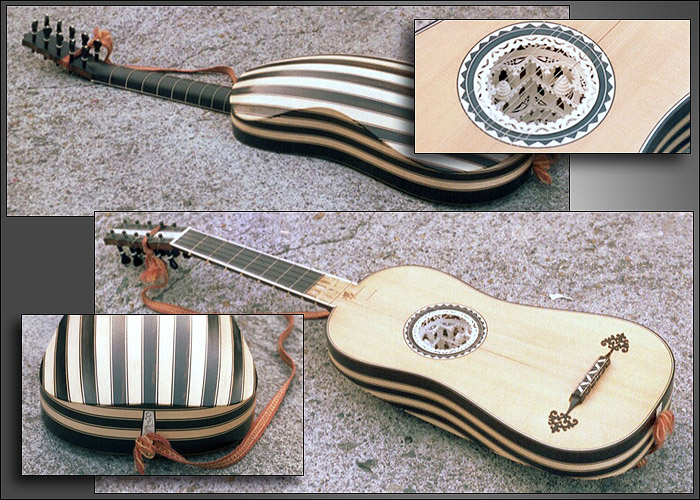
|
7-course lute in g' Was to be available August / September 2017; we'll be starting another in Deceber 2017.
To Magnus Wendel, Trondheim, Norway. 574mm, after an anonymous lute labelled: 'in Padov 1595' Very similar to the lute shown directly below, which was sold to Glen Yasharian, Pennsylvania, USA, in April 2013: 9-rib back from figured English sycamore striped with beautifully-figured quilted Pacific maple; neck and pegbox in German Elsbeere (Mountain Ash, a sorbus species); figured satinwood fingerboard edged with bone; bone fingerboard points; heart-shaped pernambuco pegs; spruce soundboard. Very clear, well-balanced tone, exceptionally clear treble and mid-range; very responsive. (further details of the original lute are under the entry No.11 in the 6-course Lutes section) £4200
This model is a very useful size for players who experience problems with some of the fingerboard stretches, and the original lute body and soundboard – with its unique rose design – are an inspiration for us to work from. It works well as both a 6-course and a 7-course. The images above show a version of this model made from timbers sawn from the same planks of maple as we are using for the new model – so it will look very similar. A previous version (below) was bought by Dr Anne Whitehouse, Leicester, in May 2012. Anne emailed us to say: "Well, it is just gorgeous. It's incredibly resonant, it has a fabulous tone, and the size is absolutely perfect for me. My playing sounds much better than it did on my previous instrument! I've been away most of the summer, so haven't had a chance to play much, but I'm now back and happy to be reunited with it It is certainly settling well into its new home".
A smaller g' lute, suitable for players who experience discomfort playing a larger instrument; it has been made in the spirit of an early 16th Century 7-course, thus it does not have a veneered neck, but is made more like a typical 6-course lute from the period, with a bridge with carved 'flower' ends rather than a later, 'scrolled' bridge. Previous sales of this model from this page: We sold three examples of this popular lute in 2009; one version had been planned to be ready in time for the 2009 Regensburg Tage Alter Musik festival, in late May; having met Thomas Höhne just after the festival to deliver a new 8c lute to him, he reserved this instrument for his 14-year old son, Tobias, agreeing a completion date for early August. We'd planned to build another one in late October 2009; this was snapped-up by Rolando Ossowski, who visited our workshop during the Summer Open Studios event here that we take part in annually; Rolando tried some instruments, and after discussing his preferences and requirements, decided to reserve the next available 7c lute, and chose this model because of his hand size, as a larger instrument was felt to be perhaps too great a stretch for him. The next example was sold to Jean-Paul Tran, a player in Grasse, France, in November 2009. The original lute upon which this model is based is an important instrument from the lute's early period; it has a very interesting rose, recalling Moorish mosaic patterns (seen in the image above) with traces of a painted pattern on the original soundboard around it, following the tracery pattern of the rose. There were also traces on the original soundboard of an earlier bridge with rounded ends; Stephen first measured it back in 1973. An example of an 'on-spec' version of this lute was sold to Doug Goodhart, of Kansas City, on November 16th 2005. Doug emailed us after receiving the lute: "Hi Stephen and Sandi, well, the lute arrived this morning. It arrived in perfect condition; I must say that I like everything about this lute. It is on the bright side, which I like, is even and projects wonderfully. You really did a great job on the set-up; it plays absolutely effortlessly. The neck is a dream to play, the finish and choice of wood is outstanding. Bravo and thanks so much. I like the trebles, but I've changed the basses to gut fundamentals and Nylgut octaves; I think it sounds great like that, but I will continue to experiment, for fun and to see what happens". Another 'on-spec' version of this lute made in recent years was sold to Joel Nicholas, of Westfield, Massachussetts, in March 2007. It was Joel's first lute, he had bought this lute as a first step into the lute world from the classical guitar; he emailed us after receiving the lute: "Good morning, Stephen and Sandi; just wanted to confirm I received the lute on Tuesday. It was delayed in NJ for homeland security reasons. You do know that lutes are such a threat to national security, that is why they fell in disfavor in the 1700's. . . The lute was received in superb condition; packaging was very well done, thank you. It is beautiful, and sounds very sweet, light and warm. What a difference from classical guitar in many ways: weight, sound, tuning, holding, technique, setting the frets, etc. I was giggling for a few minutes when I first picked it up. It is so delicate and light. I am very satisfied with the instrument; I have much work to do with it, and I've been playing/practicing almost non-stop".
The gut string maker Nicholas Baldock got on our main Waiting List for the only version of this model we were able to make in 2015; no 'on spec' versions were made in 2016.
10-course
lute £5200 (decorated version) 11-rib back from highly-figured ash; ebony fingerboard with inlaid white panel line; ebony-veneered neck and pegbox, pegbox cheeks veneered with snakewood, with bone edgings; ebony pegs with bone pips; snakewood soundboard half-edging and fingerboard points. The instrument had been fitted with wooden frets up to the twelth fret since these photos were taken; its back is made from highly-figured ash, cut from the same source as the ribs used for the previous version of this model (shown below this image).* The next version is scheduled for completion in January / February 2018; please ask us for details. *A previous version of this lute, bought by Rodney Stucky in December 2010, inspired Rod to send us these comments from Cincinnati, Ohio, on February 28th 2011: "Dear Stephen and Sandi, I've been meaning to write you to update you on how the lute is doing but it's been difficult to put down the instrument long enough to email you. I've gotten it strung to my preference; for the moment, nylgut with Dan Larson's Gimped bass strings from the 6th course on down. It sounds wonderful. The chanterelle continues to amaze me. It is bright and clear but at the same time never harsh or shrill. There is a fabulous "body" to the sound that I just love. At the moment that string is actually a plain old Pyramid nylon. I'll probably do some experimenting with some other strings for the 1st course but for now the plain nylon is just fine. The rest of the range is also truly gorgeous. I only dwell on the chanterelle because to me that's been the hardest to get right. I know the instrument is still very "green" but it still sounds beautiful and every so often I'll get some sounds, after playing it for an hour or two, that seem to be a hint of where it may go as it breaks in, what a treat. I also love the size and depth of the body. It has a wonderful balance and playability, perfect string spacing and action. I feel I can "dig in" on this instrument more than many other lutes and it responds with a nice full bodied sound. I think it's the most comfortable lute I've ever played. And then there is the visual aspect, which is just beautiful. The snakewood adds a nice subtle flair to the instrument and I love the use of snakewood for the body frets. And of course the figured ash, which works great with the snakewood, and the top are really stunning. Much more than is evident in the pictures. Speaking of pictures, it's been fun to compare the sister lute to mine on your website. The instrument is so gorgeous aesthetically I would value your thoughts on an end pin. I hope all is well with you both. As you can see I'm having a wonderful time with the instrument, it was a great investment for me and I look forward to many years of music making with it. Oh and by the way my wife, the singer, also loves the instrument and is looking forward to singing more and more with it. All the best to you both. Rod".
The most recently-made instrument is shown above; the previous version (shown below for comparison) was sold to Rodney Stucky, Cincinatti, on December 10th. The two lutes have their back ribs cut from very similar timber, sawn from the same tree. The more recent lute has Sandi's pegasus brandmark, whilst the previous one had Stephen's unicorn, as can be seen in the images below and above. Rodney emailed us this message upon receiving the lute on January 14th 2011** "Dear Sandi and Stephen, the lute arrived at my house shortly after noon, today Friday, in excellent condition. I was teaching all afternoon, and so I have just now, Friday evening, had a chance to unpack it and tune it up. It is absolutely beautiful!! And first impression, having tuned it up only thirty minutes ago, is that it sounds wonderful! I'll be restringing it as soon as I can get some strings more to my liking, but already I can hear a sound that has always eluded me with all the lutes I've ever owned (and that goes back to my first lute, in 1969). What a fabulous instrument. I'm in love and can't wait to get to work on my relationship with this wonderful instrument. More later, as I've had a chance to get better acquainted with it, but I just wanted you to know that it arrived safely and it is truly an outstanding instrument. Thanks so much. I hope all goes well for you at the exhibition in Vienna; all the best to you both. Keep up the fabulous work, Rod". **We'd agreed between us not to airfreight the lute to Rodney until the Christmas and New Year 2010 / 2011 chaos at UK airports, caused by extreme weather conditions with snow closing many airports – which had caused massive disruption and delays to all flights, including airfreight – had abated and settled down, and we could confidently send the instrument; it was delivered by us to the DHL depot in Nine Elms, London, on Wednesday evening, January 12th, and it arrived in Cincinatti less than 48 hours later. After a tiring 1000-mile drive from London to Vienna, reading Rodney's message, which was waiting for us when we checked emails in the hotel on the Friday night, was quite heartwarming. Its sister lute – built in late 2011 – found an equally happy home with Carlo Boarotto, in Sevilla, who was studying with Ariel Abramovich.
The backs of the two lutes shown above are made from a very interestingly-figured and beautiful variety of ash, which has been colour-varnished with our own-recipe amber varnish. This particular variety of ash is slow-grown, and very hard and dense; it gives a sound which is the equal of any maple or ash species we have used over the years. We have been using this particular type of ash for several recent instruments, as not only does it offer fantastic acoustical qualities, it also looks gorgeous. In recent years, we've also made the backs of several 10-course lutes (close-up details of one of them are shown below) from a very rare and unusually-figured European maple species, which closely resembles the timber of the lute in the famous Hans Holbein 1533 painting The Ambassadors (London, National Gallery – see below); one was an example available from this page, which was sold back in March 2006. This timber is used as four of the back ribs – as well as the neck – of the famous cittern by Girolamo Virchi (the one with the carving said to represent Lucretia stabbing herself through the heart) which is in the collection of the Kunsthistorischesmuseum, Vienna. We obtained a supply of this timber in 2004, and have made several instruments using it since; we plan to make a 'copy' of the Ambassadors lute – now that we are sure we have finally located the beautiful timber so accurately painted by Holbein.
Having wondered for many years if we'd ever find anything like this maple, we stumbled across it whilst searching for something else (in Romania); it is like a cross between a quilted maple, birds-eye and a burr, with a gentle but definite 'three-dimensional' character. The timber Holbein painted must have been of European origin, and not a North American maple, because birds-eye maple – which only grows in the north-eastern United States – simply was not known in Europe in 1533. Anybody familiar with the painting will know the effect, clearly seen in the images above, where it can be seen in comparison with the timber we recently obtained, used in the three lower images on a 10-course version of a Hans Frei lute, also from the early 16th Century (which would, of course, have originally been a 6-course itself). This very popular model always has a very clear, full sound; well-balanced and strong in all registers. It is very suitable for the solo repertoire, and is also very useful for accompaniment work and continuo, with its exceptionally fine, clear tone, which is very focused - as one of the most recent buyers of one of these lutes, Stephen Stubbs (the renowned soloist and continuo player) noted. Dennis Murray, of Lakefield, Ontario, who took delivery of one of these 10-course lutes in early 2004, sent us this message as an email entitled "Wow!" after receiving it: "Hello Stephen and Sandi, I have been delayed in obtaining the 10-course lute because of various work-related and travel activities. I was finally able to pick up the instrument last weekend. I must say that it is absolutely outstanding. The workmanship is very, very impressive, the rose is probably the nicest that I have ever seen. After giving the strings about 24 hours to stretch, I was able to give it a pretty good workout yesterday afternoon. Both the sound and playability are excellent. The sustain is perfect, as is the string spacing. It is just so resonant, my renditions of Vallet and Hely have never sounded this good. And yet, as you state on your webpage, the voices are so distinct. Definitely an instrument I hope to be playing for many many years (along with the 11-course, of course). Thank you very much for such a fantastic instrument, for putting up with my frequent queries. The lute was definitely worth the wait". A subsequent version offered here for sale was bought by Peter Massey, of Maidstone, Kent on June 16th 2004; Peter principally plays the classical guitar, and studied with Hector Quine. He was looking for a responsive, clear instrument for playing Dowland and others, and bought this instrument on the spot when he visited the workshop to try it. Adrian Walter, Acting Dean of the Faculty of Law, Business and Arts of Charles Darwin University, Australia, visited the workshop on the same day as Peter, and spent some time playing this instrument; a specialist in 19th Century guitar technique and performance, he was looking for a strong responsive lute with presence, that would inspire guitar students to take up the lute; he was very convinced by this 10-course Frei model, and ordered an 8-course version for the University, which has now been delivered. Following the swift sale of that instrument, and its enthusiastic reception at the Regensburg exhibition late in May 2004 (where we were still varnishing it . . .) and back here in London, we got on with building another, which was finished in late October 2004. This also sold earlier in 2005, and the next one offered here – in June 2005 – was built using the 'Holbein' maple for its back. We decided to use this special 'Holbein' maple for the lute sold in June 2005 and the one after that, to get a 'feel' for its qualities; like the majority of maples grown at a high altitude in eastern Europe, it is hard, crisp and – before varnishing – very white. Its very responsive acoustic qualities certainly help bring out the best in this popular 10-course model, and the subsequent instruments made using this beautiful wood sounded every bit as good as the first one. Another example built and offered for sale from this page was finished in late October 2006, and shown at the Herne exhibition in November 2006; it was bought a few weeks later, on December 17th by an English player, Chris Hurley, just before Christmas 2006; it and the next example we announced as being made in the early Spring of 2007 were made from figured Italian poplar (see above). Chris took away his new lute just in time for it to be an early Christmas present to himself, and sent this email from work the following morning: "I spent a good hour or two playing around with the lute and am really looking forward to getting out of work tonight to carry on. The sound is just so good – even Anne commented on it and she's pretty much tone deaf! I'll let you know how I get on over time – hopefully my fingers will get used to having so many strings to choose from. Many thanks for the hospitality yesterday – it's really good to get the opportunity to talk to makers and see some different instruments. All the best for Christmas, and hopefully our paths will cross at some point over 2007. Cheers, Chris". The second version was reserved shortly afterwards by another English player, Peter Matthews, who collected it on May 19th 2007. Peter emailed this message the following day: "I've had the first chance to play it today. My God it's a revelation! I've never played anything so responsive, and the spacing of the courses is perfect. If you pick up volume it rings rather than rattles and is so much easier to play than the EMS eight course because it's so much more responsive. Even I sound decent on it (nothing short of a miracle). Also, you're right about seeing it in daylight. The colours, especially in the shell, really stand out. The poplar works beautifully, both in look and volume. On the table you get the chance to see the real artistry of the rose including the indentation around its edge, truly remarkable work. I'm extremely pleased with it. Finally, I'd like to thank both of you for the welcome you showed me when I visited; I didn't intend to visit your workshop originally, but I'm glad I did. It was nice to meet the pair of you and it gave me the opportunity to realise just how much skill is involved in taking the raw materials and turning them into something quite so magical. Many Thanks, Peter Matthews". 8-course lute New version planned to be available in late October / November 2017
11-rib back made from a beautifully-figured, hard and sonorous ash; ebony-veneered neck and pegbox; ebony pegs with bone pips; snakewood soundboard half-edging and fingerboard points. £4600 The next example of this in-demand instrument will be ready in the late Autumn of 2017: please inquire if you are interested in reserving it. Several versions of this lute made in recent years can be seen in the images below, showing what's available in terms of timbers and rose designs; should you decide to reserve the next version of this lute, you can of course specify which timber is used for the back, and the rose design. A version of this instrument which we made in May 2008 (and sold from this page) can be seen in the images directly below; the next 2012 instrument will be generally similar. Built on the body of one of the 'Vienna' Hans Frei lutes, these lutes have a very clear, full sound – well balanced and strong in all registers; an example of this lute was played and admired by several players at the May 2008 Regensburg Tage Alter Musik exhibition, including by Ronn McFarlane, who liked it very much. Images of other versions – all made and offered for sale on this page in recent years – are shown below; these images illustrate the variety of timbers and rose designs that are available with this model.
A previous version of this instrument which we completed in late December 2007 was sold to Erik Corsmit, in Antwerp, on January 31st, while we were en route back from the Resonanzen 2008 exhibition in Vienna. Erik contacted us via email while we were staying with friends in Holland, en route back to London from Vienna; the following day, we were able to meet him (having taken on the Antwerp Ring the only way you can – by driving as 'creatively' and as fast as those around you – a turbocharged car is useful when attempting this). We showed him the lute, which he bought on the spot. Erik's lute has a back made from a highly-figured and unusual ash, very similar to the original Hungarian Ash which we obtained in the aftermath of the October 1987 Hurricane. This particular timber – from an old, slowly-growing tree – came from the north of England, and its grain is very similar to true Hungarian Ash, but with a slightly more 'marbled' figure. Images of the most recent version of this lute made from this wood – completed in May 2008 as an order which came up on our waiting list – are shown above.
The lute shown above was sold to Mark Maier, of Lake Geneva, Wisconsin USA, on October 23rd 2006. Mark sent us this email upon receiving it: " Stephen and Sandi, it has been said that "good things come to people who wait", and while in the grand scheme of things I didn't wait long, the phrase should instead read: "spectacular things come to people who wait". The instrument is a true work of art. And, it sounds equally as spectacular as it looks. I could not be happier! Now all I have to do is develop some lute 'chops', as it were. Thank you again for your kind indulgence with my pestering phone calls. It was a pleasure working with you both, and I hope that I can sometime visit your workshop. With kindest regards, Mark Meier". (The body frets had not been fitted when the photographs above were taken, but the instrument was subsequently fitted with its fixed wooden frets, up to and including the 12th fret).
Another example, made in July 2007 – shown above – has a back made from a very hard and beautiful, silkily-flamed maple, which came from a tree which was blown down almost 20 years earlier, on Clapham Common, south London, in the Great Storm of October 1987. We have made several instruments from this timber, and another 'on spec' eight-course lute which we offered here in 2007 had its back built from it; the ribs were striped, sawn from two adjacent planks. The rose design of the lute shown above is from the well-known 'Warwick' Hans Frei lute. The back of the example which had been available earlier in 2007 is similar to that of the September 2006 instrument shown in the images directly below (ie, figured, flamed maple with a subtle, almost silky figure). Its rose has the design shown in the image above; it was bought by Eligio Quinteiro in March 2007. This first 'on-spec' example offered here in 2007, which was finished in January 2007, was sold to Eligio, a Spanish player based in London, on 5th March. Eligio visited the workshop on St. Valentine's Day, February 14th, to order a guitar and a vihuela; he came back again on Saturday March 3rd to try a newly-finished liuto attiorbato, and noticed the 8-course lute, which he liked very much, and asked to take it away to try. Later in the afternoon of March 5th, Eligio sent a text (SMS) message from his cellphone, saying: "Dear Stephen & Sandi, I'm SO buying this lute!". He hadn't even been thinking of buying a new Renaissance lute when he came here on that Saturday afternoon in early March 2007, to order a baroque guitar and a vihuela . . . we'd only showed it to him to illustrate a ponit about amber-based oil varnish (which the lute is varnished with); he couldn't put it down.
The lute shown above was the featured instrument played in an interesting concert on Friday 15th September 2006 at the Purcell Room, at the South Bank, London, given by The Dowland Project. The concert was part of Inspirations: The Early Music Weekend (artistic advisor Tess Knighton). The Dowland Project were: John Potter (tenor), the lutenist Stephen Stubbs, Susanna Pell (gamba) Milòs Valent (violin) and the distinguished British jazz sax player and composer John Surman (who was brilliantly playing bass clarinet and soprano sax continuo). John Dowland was the featured composer. Their performance of Flow My Tears was absolutely stunning. In his forward to the programme, John Potter remarked: "One of the intentions behind our Dowland realisations is to try and recapture the sense of prima vista that performers felt when they encountered new music. No one presumably worried about the things that concern musicologists, such as the appropriateness of instrumentation, adhering to the composer's wishes and other matters of what we now call performance practice. We have no mission to educate or inform (we have no musicological shopping list) – we just want to play the music". The Dowland project have released two CDs on the ECM label, In Darkness Let Me Dwell (1998) and Care-charming Sleep (2002). Further recordings were made earlier in 2006, with the participation of the Slovakian violinist Milòs Valent, which included songs from the original Carmina Burana ms. and versions of Mass movements by Josquin Desprez and Lassus.
Above are details of the back of another of these 8-course Frei lutes – also made from figured poplar – which was sawn from the same plank as the model sold to Mark Meier, shown two images above. In late 2005 and early 2006, three 'on spec' versions of this instrument offered here were reserved and bought by players in Italy and England (Luca Manassero, Michael Lynch and Peter Greener) in quick succession. One of the versions sold from this page in February 2006 was reserved by Michael Lynch, from Somerset, England, who visited the workshop on 3rd February, and was able to choose the rose design and the timber for the back of the then forthcoming instrument (Michael chose flamed maple for the ribs of his lute). He had read this section of the website, and noted that Luca Manassero had reserved the then most recent version of this model in December 2005, and had been able to collect it from us in January 2006. Having visited the workshop on 3rd February to confirm his reservation of the then-forthcoming 8-course lute, Michael subsequently collected it on March 23rd; he sent us this email upon his return to Somerset: "Hello Stephen and Sandi, just to let you know that the lute and I arrived home safely, but unfortunately not before nightfall. It wasn't easy to get out of the urban ant-heap! Many, many thanks for making such an instrument for me and for spending so much time talking about your art and craft. For those who cannot visit your workshop, your website is a wonderful representation of your expertise and enthusiasm. I do believe it is a resource for all who are interested in fine instruments and I can well imagine that existing and prospective customers will return to it often for consolation and encouragement in a less than perfect world. Right now I am in the foothills of the learning curve but it is going to be fun! Kindest regards, Michael". (A year on from his first visit, Michael ordered a fluted-back vihuela from us, following another visit to our workshop on March 2nd 2007). Luca's 8-course had been under construction in December 2005, and had been pencilled-in for completion in early January 2006 – our original plan being to exhibit the lute at Resonanzen 2006; however, almost as soon as we announced its forthcoming availability, it was reserved by Luca, who lives in Portogruaro, Italy. He travelled to Vienna to collect it from us during the Resonanzen 2006 festival; it was very similar to the version shown above, using the same timbers for the back; Luca subsequently emailed us, having had the new lute in his possession for a few days: "Dear Stephen and Sandi, a quick note to let you know that your lute went from Vienna to Köln, it has been of great company during my business trip there, then finally reached Portogruaro on Friday night. It is a stunning instrument with a very rich voice, improving every day, even under my poor fingers. I couldn't be happier with it. It strongly demands to be played much better than I actually do, therefore helping me to spend every single free minute with it. I am probably the only travelling businessman with a renaissance lute; nobody ever complained and hopefully never will. By the way, I see another lute in my future (a baroque one, this time). I keep a very warm and friendly memory of our meeting and hope to see you soon in London. Kindest regards from Alessandra and myself" The previous 'on spec' 8-course lute of this design was bought by Nick Makris, a scientist from MIT, Boston and an accomplished player of many plucked, stringed instruments; Nick collected the lute in person from our workshop, and subsequently emailed us: "Dear Stephen and Sandi, the lute you made for me is a masterpiece. I've had the opportunity recently to play some other finely crafted lutes, and your creation is a special instrument; it comes alive. I play it all the time and it's the one thing guaranteed to put my mind and heart at ease. It took several weeks to really learn how to play properly. At first, I was playing a bit too aggressively, the fingers too used to macho flamenco stuff, guitar action and wide string spacing. But making pieces like Dowland's 'Go From My Window' and Bachelor's 'Monsieur's Almaine' sound and feel right forced me to cut my finger nails and use what I now read is close to 'correct' lute technique, which is really cool. Playing pieces like Johnson's 'Fantasia' on it just sends you to another world. I can now see how those people in the Renaissance got by without electric guitars! The lute doesn't need an amp for that extra tone colouring, it's built-in, at least when it's made properly. You may not like it, but Jimi Hendrix tunes like 'Little Wing' sound really cool on this lute. There's an electric guitar crispness and punchiness you don't find on other acoustic instruments. I think it's no coincidence that the Henry VIII tune 'Pass Time With Good Company' has the same chords as 'Little Wing' ".
Above: the lute we made for Nick Makris in 2005. The instrument has a back from quilted maple striped with birds-eye maple, and has an inlaid bone & ebony heart in the lower soundboard; the rose design used is from the Warwick Castle Hans Frei lute. An earlier version of this model offered here in late 2004 was bought at the end of December 2004 by Tim Watson, an English architect and interior designer who lives and works in Milano. Tim sent us this email after returning to Milano with his new instrument early in January 2005: "The lute is great, everything it promised on the box (the web site). I feel it was made for me, apart from the stroke of luck that left it sitting there waiting for me to call, but also the strings always seem to be exactly where I need them for both hands, the string length is well suited to my fingers (they don't get in each other's way anymore). Every string on every fret has a clearly distinct and even tone, in the true sense of the lute; I seem to be conducting a choir rather than plucking a single instrument, that for me is an impressive achievement. The brightness gives a possibility of expression and subtlety that I can enjoy". Another 'on spec' example went to lutenist and viola da gamba player Din Ghani, of Westbury, Wiltshire, 14th July 2007, who collected it on his way to the Viola da Gamba Society week in Benslow. He sent this message after returning home from the Benslow course: "You'll be pleased to know that the lute came through its baptism at Benslow last week with flying colours. Playing the Lachrimae dances is much more enjoyable when you can really hear yourself coming through the viols – the lute certainly had the right combination of clarity and power, especially in the middle range, which often gets lost in that sort of ensemble. Thank you for such a lovely instrument – even though I'm still in the process of getting to know it, it already feels comfortable. The back is really striking, and I dined out well on the Clapham Common story**. At some stage I'd like to try all-gut stringing, similar to Eligio's". (Eligio Quinteiro, who bought the previous example of this model in March 2007, brought his instrument to the workshop to show Din, when Din first approached us to try one of these lutes, back in April of that year). **The subsequent example was ready in late December 2007, its back made from a highly-figured ash, very similar in appearance to Hungarian Ash; it was sold on February 1st 2008 to Eric Corsmit, in Antwerp. The next version – made from the same timber – was sold in July 2008 to an English player, Richard Reffold. A fairly recent model (announced in July 2013) was sold to a player in England. We're planning to make the next version to be available in October / November 2017. 6-course
lute in a' New version planned to be available in late March / April 2018 £4200 The next version of this instrument will have an 11-rib back, made from figured ash; a highly-figured, haselfichte spruce soundboard, and a neck and pegbox from pearwood. It will also have heart-shaped pegs made from pernambuco, and a satinwood fingerboard which extends onto the belly, edged with bone, and bone fingerboard points. Images of similar instrument sold from this page are shown below; we plan to display here images of the new version of this lute when ready. If you are interested in reserving it, please let us know.
Above: a similar, recent instrument in progress; the composite image above shows work-in-progress of the 6-course a' lute we completed and sold over the summer of 2011. It is made from a very highly-figured, hard 'quilted' maple, the 11 ribs sawn in sequence from a single plank. In the images shown above, the lute's back is still sitting on its mould, and the outer ribs have not yet been cut back to the block. For those interested in tools, the plane in the foreground is an 1896 Stanley 'Rabbet & Block Plane' No.140, a skew-plane (ie, a block plane with its blade set at an angle). In the background, Sandi can be seen working on its rose, a close-up of which can be seen to the right of the image above.
The lute above was bought by Catherine Lorigan, for whom we made a Student Lute a few years back; Catherine visited the workshop to have some minor adjustments and maintenance to her lute, and fell in love with this instrument at first sight; its back, made from a very highly-figured quilted maple, was finished with the oil-based amber varnish which we use for white woods such as ash, maple and sycamore. Very clear, with a rounded, full sound; although relatively small, these lutes have a very special sound and 'presence' and are particularly well-suited to the more demanding 6-course repertoire, where some of the left-hand stretches can be quite difficult. It works extremely well with all-gut stringing.
Above: three 6-course a' lutes photographed in Peacock Yard in February 2011; the one in the centre has a back made from Hungarian ash, and was ordered by Andrei Vanazzi, a Brazilian lutenist. The instrument on the right has a back made from consecutively-sawn slices of highly-figured ash very simlar to Hungarian ash, and was recently sent to Stanislaus Germain Thérien in Quebec. The third lute (on the left) is owned by us, and it has a striped back made from two cuts of figured ash; we keep this lute at the workshop for visitors to try, Andrei Vanazzi, a player in Brazil who we sent a recent version of this lute to (a regular order from our waiting-list, rather than an instrument sold from this page) wrote to us thus upon receiving his new lute: "Dear Sandi and Stephen, the lute is amazing, again congratulations for your work. It has a beautiful and smooth sound. It is an instrument that makes every single note clear not only making it ideal for playing polyphony, but also it is an instrument that can easily be played at speed without losing the "angelical beauty" of the lute. I'll be happy to indicate you to other lutenists in Brazil and Latin America that I know and will meet in the future. Once again thank you for having received Michelle in your office and having the patience to make business with me. Being a musician in Brazil, it is really difficult, especially when you're in a sector not much known here in my country, such as early music. I wish you all the best". (the lute was collected on Andrei's behalf by a friend of his who was studying in London at the time, Michelle de Castro). Axel Wolf, playing the version in the main images at the top of this entry, at the May 2004 Regensburg Tage Alter Musik festival exhibition, was very impressed by its strong, well-balanced and clear sound, and its singing chanterelle, as was Munich-based lutenist Christoph Eglhuber, who subsequently ordered a 7-course version of it; this order was delivered at the 2005 Regensburg exhibition, along with a 6-course version, ordered by Uli Sommerrock, of Ingolstadt. Both were very pleased with their new instruments; they both praised the build and tonal qualities of the three a' lutes, as well as their responsiveness and playability. At the January 2006 Vienna Resonanzen exhibition, this lute (now owned by James Yorke, curator of the instrument collection at the V&A, London) was admired by many players, who commented on how much sound it had for such a relatively small lute; everybody remarked upon the beautiful wood of its back. Violin and gamba-making colleagues at the November 2006 Herne exhibition admired the colour and transparency of its varnish.
Coming up soon These instruments are currently under construction, and will become available later in 2015; please inquire for up-to-date details.
5-course French Baroque Guitar One available now, one later in 2017.
£5600 We are planning to fit in another example of this popular guitar, to be ready in late Autumn 2017; please feel free to get in touch if you are interested in reserving it. Five-piece back of beautiful, fine-grained quarter-sawn Italian cypress (see images below) with black/white/black (ebony/holly/ebony) stripes in between; figured walnut sides; ebony-veneered neck and pegbox; ebony pegs with bone pips; classic Voboam 4-tiered parchment rosette. The original instrument has the distinctive black & white 'Voboam' chevron decoration around its belly and along its neck; however, for this guitar, we've adopted the style and detailing of other surviving, plainer guitars by Alexandre Voboam (the 1690 double guitar in the Vienna KHM and another guitar dated 1652) neither of which have the black & white chevron decoration. This keeps the construction and materials costs of this model down, whilst producing a guitar which is historically correct in terms of its design, construction and aesthetics. It's quite clear from a few surviving plainer yet very elegant models that the Voboam dynasty built working, 'everyday' instruments for professional players, as well as the highly-decorated guitars for wealthier players for which they are more famous. A 'classic' French flat-back guitar, with a very clear and full sound, excellent for both solo and continuo playing; very similar to the guitar shown here, using the same materials and detailing. A fairly recent version of this guitar was made for Negin Habibi, the Hannover-based Persian classical guitarist, who collected her instrument at the Regensburg Tage Alter Musik festival in June 2012. She wrote: "Hello Stephen, I want to thank you and Sandi very much for this beautiful guitar. I'm very motivated to learn how to play it. Greetings from Frank Bungarten. Best Regards, Negin". Another interesting example went to Barcelona player Martí Beltran Gonzalez, who emailed this message to us in mid-December 2010: "Hi Stephen and Sandi, Thanks for the strings and for the guitar. The guitar is growing and it has no limits. It's a lot of money but it's a great instrument and I'm very happy with it. Thanks for all and a very happy Christmas and a New Year. Best luck in 2011, Mart’".
Currently
our most sought-after baroque guitar: Stephen Stubbs, Andrew Maginley
and Radamés Paz are among owners of this model who use it constantly
– it's a guitar that more than earns its keep. They've all commented
it's the best baroque guitar they have ever played. It works extremely
well with gut stringing, we recommend Nicholas Baldock's excellent
Kathedrale gut strings.
A previous version of this guitar went to Bruce Brogdon, of Houston, Texas, in mid-May 2005; having received it, he emailed us: "The sound is wonderful, and it plays very well. My previous instrument has a rather 'blocky' neck, and I ended up not playing the guitar repertoire for the last couple of years. It is great to get back to it. As I continue playing this guitar, the more glorious it sounds!" A subsequent version was reserved on May 4th 2006 by James Meadors, of Boston, Massachusetts; James wrote upon receiving it: "Hello Stephen and Sandi, I just wanted to let you know that the guitar arrived this afternoon and is in perfect condition. I haven't had a chance to play it much, but my initial impressions are very, very positive. The workmanship is beautiful, the woods are attractive and harmonius, and the rosette is magnificent. As a classical guitarist, I relate very easily to the sound and feel; the sustain is excellent, making slurs very easy, and the quality of the sound is very beautiful. I will write again after I've had a chance to play it more, but I'm pretty sure I'm going to love this instrument!" The next version had been under construction and well underway – following completion of James' guitar – and was planned to be ready for late August / early September 2006, but postponed until November 2006 and exhibited at the Herne Tage Alte Musik 2006 festival; we'd prepared the wood for another guitar whilst building the instrument that James had bought. We went on to sell that November example (which was also exhibited at the January 2007 Resonanzen exhibition) to Elizabeth Brown, who lives in Seattle. The next one – made in the spring of 2007 – went to composer and guitarist Mark Mancina, who lives and works in Carmel, California, and the other versions offered in 2007 were bought by Evert van Berkel in Stockholm and Keith Richards in West Wittering. Examples of this guitar made in 2007, 2008, 2009, 2010, 2011 and 2012: Three previous versions of this instrument which have been offered here on this page since January 1st 2007 were sold, to, respectively: Elizabeth Brown, of Seattle, Washington, on February 1st; Mark Mancina, of Carmel, California on March 21st (Mark is a classical guitarist and film composer who works in Hollywood. responsible for the soundtracks of films such as Speed and The Lion King) and Evert van Berkel of Stockholm. Evert bought his instrument in the summer of 2007; he emailed us upon receiving it: "Hi Stephen and Sandi, the guitar arrived safe and sound yesterday evening in Stockholm. As I was producing a live broadcast from the Henze festival at the Stockholm Concert Hall yesterday evening and came home rather late I did not have the opportunity to play the guitar properly yet, but the first impression after tuning up is that it is a beautifully-built, good-sounding instrument and I am for sure going to be very happy with it". We had been planning another example for completion in September 2007; however, following the serious illness and subsequent death of Sandi's father Tony (there is an account of this and an obituary on the Gallery page) it was not going to be ready until December. Interestingly, it was reserved by Keith Richards (yes, that one) who had been filming the latest in the Pirates Of The Caribbean series, in which he plays Johnny Depp's father, and plays a 5-course guitar. Keith – who plays a 5-string electric guitar – decided he wanted one of his own, and felt that the '10-string' guitar would fall easily under his fingers; it'll be interesting to see what he does with this guitar. We were not able to find the time to build another of these guitars until earlier in 2008; Tuomas Rauramaa, of Jyväskylä, Finland, having reserved it, received his guitar in the Spring of 2008. After he'd received the guitar, Tuomas emailed us: "I have had the guitar for a week now, it reached me safely. It is really a wonderful instrument. The workmanship is excellent. The upper register is very clear and the lower is nicely full, making it ideal for both solo and continuo. The general sound and feel of this guitar is just like the idea of a baroque guitar I had in my head when I decided to get one. Best Wishes, Tuomas". The next available 2008 guitar was reserved by Simon Lilley from Bolton; Thomas Zapf, a German player in Bamberg who owns one of our vihuelas, reserved the next version of this model. Having sold the three instruments that had already been pencilled-in for 2008, and responding to demand for this model throughout 2009, we were only able to build three versions of it which were offered for sale in 2009, and subsequently all sold. The first version we were able to make in 2010 was reserved by Frode Olsen, a Norwegian player who'd previously bought an 8-course lute from this page, in late April 2010. 2011 The first version we were able to make and offer for sale in 2011 was reserved by Stig Ola Føll, another Norwegian player. 2012 – 2016 We completed work on another example in August October 2012; it was bought by a player who wished to remain anonymous. We were not able to make any 'on spec' versions of this guitar to be offered for sale on this page during 2013, 2014, 2015 0r 2016; however, please feel free to inquire if you are interested in acquiring the current version, made in late 2016 / early 2017, or reserving the next version, planned for the late Autumn of 2017.
11-course
French baroque lute £5200 Available in late August 2017
To Nels Johnson, London. We had started work on another example earlier this year, which we planned to have ready in the Summer of 2017; it was recently reserved. The previous 'on spec' version of this lute, offered on this page a while back, was reserved by Bob Reynierson, a long-standing customer who has bought a few instruments from this page of our website. Bob emailed us after having played the lute for a while: "Hello Stephen and Sandi, I've been working my way through Sedoura's tutor and have several pieces more or less in hand on the new eleven course lute. It is such a rewarding instrument to play! The sound is rich, full, and clear, the timbers you chose are superb, and as always your workmanship is excellent. It was well worth the wait. Wishing you a hearty winter solstice (I understand the Norse tradition was to set the largest log to be found afire and party until it went out), a Merry Christmas, and a happy and prosperous new year". Built on the very beautiful Warwick Castle original; 11-rib back in very pretty figured maple; walnut neck & pegbox; ebony fingerboard, fingerboard points and half-edgings; plumwood pegs. We've set the string length of this lute at 700mm – very close to the original lute's existing string length, from its most recent conversion to an 11-course instrument – which gives a neck with 9 tied frets, the 10th (fixed, wooden) fret is at the neck/body join. The instrument shown here below has its soundboard made from a highly-figured variety of spruce, Haselfichte.
We built this instrument in the spirit of the two other surviving original Hans Frei lutes in the Vienna Kunsthistorischesmuseum collection, and fitted it with an unveneered walnut neck & pegbox, rather than the decorated neck and fingerboard with which the original Warwick instrument is fitted. It has the stunning 'Warwick' Frei rose design which the original has (the Warwick Castle original has had anachronistic decoration applied to its neck and fingerboard in the 19th Century, which we of course ignored when considering the design and style of this model). The following reference from the Mary Burwell lute tutor of 1660 is thought-provoking, and certainly the description of an un-veneered neck and pegbox tallies with two of the surviving Hans Frei lutes in the Vienna KHM – both of which were converted to an 11-course setup; this was what inspired us to build an 11-course lute along the lines described above. "The flatt part of the Necks of the Lute and the bridge are to be made of ebony, but to Cover the head, the back of the necke with it as some do is improper because it makes the Lute too heavy upon the left hand the neck cold and slippery for the Thumbe and the frettes are never fast, a neck made of a light wood with a fine varnish as neare as may be to the colour of the Lute but you must keepe it cleane".
We built the example shown here – based upon the beautiful original Warwick Frei lute – with a back made from flamed maple, and an unveneered walnut neck and pegbox (the walnut used was from a large tree which fell in Canterbury in the Great Storm which ravaged southern England in 1987). Note that the bone nut extends beyond the bass edge of the neck, as seen on some original instruments, and also clearly visible in the engraving of the French lutenist Charles Mouton by Gérard Edelinck. The instrument was fitted with unstained, plain plumwood pegs (from Essex – from a tree also blown down in the 1987 Great Storm) which have a beautiful terracotta colour which nicely complements the walnut and the colour of the oil varnish used on the back of the lute. Archlute
The most recent version of this model, shown above (in its Kingham case) – which we have made around twenty of over the past decade-and-a-half – was made for the late Stephen Toombs in 2016. It was kindly donated by his widow Jean to the LSA instrument rental programme. (own design) 650/1400mm (6x2 / 8x1 or 1x1, 5x2, 1x1 / / 7x1) Pitch: f#' or g' (can be tuned to g' with a' = 440 Hz) Very attractive back of 25 fluted ribs in Santos rosewood, with holly spacers between; matching endclasp, with pretty snakewood insert (see image below); snakewood soundboard half-edging and fingerboard points; lower neck veneered with ebony, upper neck veneered with ebony front and rear, the front face with triple white/black/white edgings; ebony pegs with bone pips; triple rose. A very useful size of archlute when it is likely that a lot of work is done with ensembles who play at a' = 440 Hz; it of course works extremely well at 415 Hz. Its string length of 650 makes it a little easier to play than the more 'typical' 670mm, whilst providing a properly-proportioned neck with the 9th fret at the neck/body join. £6000 A new version, very similar to the instrument shown here, is planned to be ready early in 2018; it will be built according to the specification listed above. A recent example was sold to Erik Corsmit, a player in Antwerp; Erik had previously bought an 8c lute from this page in February 2008. Previous versions of this model offered here were bought by Dr Philip McLaughlin, of Sligo, Eire, by Dr Charles Browne, of Cumbria, England, and by Isabella Foddai, Tuscany; Philip and Charles bought finished 'on spec' archlutes, whereas Isabella reserved a forthcoming 'on spec' instrument, and was thus able to specify its bridge and fingerboard spacings. Isabella – who is quite petite – emailed after receiving her new instrument: "I spent the weekend playing with my new instrument; you were right, he has a good action, and the string length is very suitable for me. I'm really interested in a new baroque lute, and I would come to your workshop and see and play some of your instruments, but until the end of the year, I'll be really busy with the school. I'll send you more details in the next week. I've never played on Kathedrale gut strings: really amazing! My kindest regards and best wishes for your future plans . . . please Stephen, be careful, we need you!" (Isabella was referring at the end of her message to the bandsaw accident which Stephen suffered in July 2008).
An example that we made at the beginning of 2006 went to Alfonso Marin, a renaissance lute and continuo specialist based in Amsterdam; we delivered the instrument to Alfonso in Utrecht, on Monday January 30th (on our way back from Vienna) in Le Marché, in the Vredenburg centre, where you can buy freshly-squeezed orange juice, good food and damn fine coffee. A bit like Ed's Diner; Agent Cooper would probably approve. Alfonso emailed us, having had the opportunity to play the new instrument: "Dear Stephen and Sandi, I wanted to write you before to inform you about the archlute, but I am having a very busy period trying to catch up with all the work I could not do when I was ill (just a few days after I met you, I got a terrible influenza). With the illness and all the work after it, I almost didn't have time to really try the instrument out. First of all, let me tell you that I love the instrument and I am sure it will serve me well for probably the rest of my professional career. The craftsmanship of the instrument is amazing and it is the best I have ever seen (sincerely). It gives me a lot of pleasure to own such a beautiful instrument. Concerning the sound, I am quite happy, having in mind that in only a few practice sessions the instrument has evolved amazingly well. At the beginning, I had a feeling of a certain stiffness in the sound that is gradually disappearing, evolving into a much more colourful sound. I like its clear, bright sound. Although I haven't had the opportunity to try it with other instruments in a concert or rehearsal situation, I have the feeling that it will project well and will be clearly heard when playing with large ensembles. That was my main goal when I decided to purchase an archlute. I will keep on reporting as I get to know the instrument better". Another example of this model – an order, rather than one made 'on spec' – was shipped to Bob Reynierson, of Gainesville, Florida; that made four of these models built that year, 2013. Bob Reynierson emailed us, having received the new instrument: "The archlute is a very handsome instrument indeed! Your workmanship and aesthetic sense are, as usual, superb. The lute is remarkably well-balanced, and when seated low enough I can comfortably hold and play it without a strap. I have not yet brought it up to pitch, but even a half-stop below the working pitch the tone is very warm with a clear and vocal-sounding bass. I'm looking forward to hearing it in ensemble with other instruments". We sent an identical model of this archlute to a Japanese customer, Takahashi Masakazu, of Miyagi Prefecture, Japan; his comment upon receiving it was: "Excellent, with three exclamation marks!!! It was worth the wait". Stephen Stubbs has one of these models, and uses it a lot for continuo playing, finding it less of a 'handful' than the larger Harz model which we'd made for him previously – but equally loud and clear.
Theorbo in a-tuning (lesser French theorbo) (own design) 760/1400mm (7x2 / 7x1 or 7x1 / 7x1) or 6x2 /8x1 (or 8x1 / 6x1 tuned in d', for Robert de Visée) Pitch:a (or d', depending upon stringing) £6000
To Brigitte Pettipher, earlier in 2017; she is a French player who Stephen built an archlute for in the early 1980s when she studied with Nigel North in London; she returned to lute playing after an extended sabbatical. Specially designed for Brigitte, an image of her first encounter with the new instrument in our workshop is shown below. We plan to start another version of this model in the early Spring of 2018.
We were unable to build any 'on spec' versions of this theorbo for most of 2015 and into early 2016, due to pressure of work; the previous forthcoming 'on spec' version made in late 2013 was reserved by Rob Taylor, a harpsichordist and continuo specialist in Hampshire, England. its mould being in otherwise more or less continual use to fulfill existing orders, we are planning to get another 'on spec' instrument started in the early Spring of 2018. A very loud and clear instrument; more than the equal of much larger instruments, demolishing the modern myth that so-called 'small' theorbos don't have much sound (never mind the silly ill-informed canard that 'small' theorbos – which this isn't by any stretch of the imagination – didn't exist). We beg to differ; and it's practical too, its shallow body making extended playing comfortable, and also of course helping its excellent projection, as a large number of satisfied owners would happily testify. A model that we have developed and refined to be a very practical and useful instrument, having made a large number of examples of. Very attractive back of 11 ribs in rosewood, with holly spacers between; matching endclasp; snakewood soundboard half-edging and fingerboard points; bookmatched, figured snakewood fingerboard central panel; lower neck veneered with ebony, upper neck veneered with ebony front and rear, the front face with triple white/black/white edgings; ebony pegs with bone pips; triple rose. This instrument will have a bookmatched snakewood fingerboard central panel, and double stringing available on the fingerboard courses; the beautiful and startling figuring of the snakewood fingerboard – panelled with ebony and an inlaid white line – nicely matches and complements the colours of the rosewood body ribs. This instrument can also be strung and tuned in d', for playing the dedicated French repertoire, including of course the pieces by Robert de Visée.
The images below are of a previous instrument offered here (owned by Philip MacLaughlin, of Sligo, Eire).
This theorbo, one of our most popular continuo models, has a very elegant and comfortable-to-hold body, with a shallow profile, which helps to give excellent projection and clarity - far louder than many other makers' larger instruments, according to the many customers who have ordered or bought one. The example shown above is set-up with the possibility of 7 double courses on the fingerboard, as well as 7 single courses; this is because we have drilled the bridge to allow single-stringing as an alternative. It is shown here with single stringing, 7x1 / 7x1, but there are enough pegs to allow 8x1 / 6x1 as well as 6x1 / 8x1 string dispositions. A very clear, loud and well-balanced instrument, eminently suitable for solo and continuo use; a recent buyer of one of these instruments, Wim Maeseele (of Bruges) has gleefully commented that he manages to drown-out the string section when he wants to . . . and it easily fits in his Volvo V70*. A 'Toy' Theorbo ? *Notwithstanding the silly, inaccurate description of theorbos of this size as 'toys' by some ill-informed and inexperienced 'theorists', this is a theorbo which is the equal of many instruments which are much larger. We've probably made more theorbos than any other makers around in modern times; we've worked with and for most of the leading players, we listen to and learn from players, and as luthiers with decades of experience behind us, we bring this knowledge and skill to everything we make, including this model. We know what works and what doesn't, and we would not offer this model if we were not only 100% confident that it works extremely well, but also because it is based upon historical examples and our own careful research. And just why should enthusiastic, gifted and passionate players who just happen not to be tall, be told they cannot play a theorbo? This model is equally useful for solo and continuo playing. An example of this instrument was bought by Victor Anand Coelho in December 2004; Victor – a lutenist and continuo specialist, and Professor of Music at the Boston University School Of Music – is author of 'Performance on Lute, Guitar and Vihuela' (Cambridge University Press, 1997, ISBN 0 521 45528 6 hardback). Victor recently contacted us, he's using the theorbo extensively; he wrote: "Just a note to say that I play the instrument a lot – it's on Boston Baroque's Four Seasons album, but better yet, I play it on three duets of Castaldi (with tiorbino) from my group's latest album, including the 14-minute 'Battaglia'!" Here's the link: You can listen to one of them at: http://people.bu.edu/blues/music_record.html They can also be found on iTunes. Some previous versions of this theorbo made and sold from this page of the site: Following the swift sale of two examples we built in the summer of 2003 of this lesser French theorbo model, which went to a player in Trondheim, Norway and to Yasuhiko Suzuki, of Tokyo – and the subsequent interest shown in the availability of further models, we started building another over the late summer of 2003, which was shown in an unvarnished state at the Bremen L'Accademia d'Amore course between September 21st - 28th a few months later, and bought by Clive Ray, of Trieste, Italy. Espen Jorgensen – a guitarist from Norway who was attending the course at our suggestion – decided to order one for 2004, having been inspired by the wonderful creative musical environment that Stephen Stubbs and the other teachers create at L'Accademia d'Amore. Having moved back to Seattle, Stephen & Co have resumed the annual course there. The example which went to Yasuhiko Suzuki was tried by Clive Ray just before it was airfreighted to Tokyo, and Clive decided to take the next example being built (the one exhibited in Bremen) and although it was broadly similar to the example shown above, he specified certain personal preferences, such as left and right-hand string spacing, single 7x1 / 7x1 stringing, upper pegbox decoration, and Clive also selected the rose design during his visit to the workshop. Clive flew to London in November 2003 to collect his new instrument, and sent us this message upon returning home with it: " Dear Sandi and Stephen - well, we both arrived safely in Trieste; when I did open the case at home, my wife and daughter were both stunned by the beauty of your craftsmanship. I certainly appreciate, in both senses of the word, the effort you went to in order to get the instrument ready on time despite the unfortunate circumstance of the burglary at your flat. And the sound! It's as though you've managed to pack the acoustics of a small concert hall into the sound box. Notes plucked on my old guitar sound like dull thuds in comparison. So thanks again. I'll let you know how I get on as I learn to play ". The next instrument we were planning to build for December 2003 was reserved – just after Clive had snapped-up his instrument – by Michael Miranda of Alhambra, California; with this example made and shipped earlier in 2004, we were subsequently able to complete the next one, which was exhibited at the 2004 Utrecht Oude Muziek Festival exhibition over the weekend of August 27th - 29th. This instrument was subsequently bought by Victor Anand Coelho in December 2004 (see above). Two more were made as customers' orders in 2005, and a third example we built during 2005 – made 'on spec' – was bought by Philip MacLaughlin, a surgeon from Sligo, Eire. 13-course
lute We plan to start work on another example in the late Spring / early Summer of 2018; please let us know if you are interested in reserving it. Bass-rider type; 11-rib back in very pretty Santos rosewood, with holly lines between the ribs; ebony-veneered neck & pegbox, ebony fingerboard with snakewood fingerboard points and soundboard half-edging; bone lines inlaid into ebony bridge top veneer, bone bridge points; plumwood pegs fitted with bone pips (bass and treble rider pegs have bone end-finials also). Two bone buttons, one on the endclasp, the other on the central rib near the neck. Very similar to the instrument shown here, below (top set of images). £5600 A previous version – shown below – was sold to William Roberts, Washington DC, who reserved it in February 2012, and collected it from our workshop on November 25th 2012. A previous version of this instrument was ordered by Ben Elliott, who studied with Jakob Lindberg at the Royal College Of Music, London.
For a recently-sold version of this 1744 Schelle lute (sold to Joseph MacLaughlin) we used a similar, dark, veined rio rosewood to that used on the original; the lute shown above also has a back made from this particular stock of rosewood. These lutes are very popular, and because we are happy to respond to this demand, we'd previously made versions of this lute – sold from this page – to classical guitarists reserved by Nils Gesbert in France and Kurt Decker in Denmark; Kurt had previously bought an 11-course lute from this page in 2007, and Nils went on to reserve and buy an 'on spec' 10c from this page in early 2013. Another previous version of this lute, airfreighted in November 2008 to Tyler Hawkins, who lives in Hay River, NW Territories, Canada, was built with a carved & pierced pegbox rear, and a ' dolphin' treble rider as extra, specified decoration, requested by Tyler. Tyler had reserved a forthcoming version of this instrument late in 2007, and requested extra decorative elements. The instrument was airfreighted by FedEx to Calgary, a considerable distance south from Hay River, but Tyler's preferred delivery address; after collecting it from Cochrane, near Calgary (where it was sent by us to his family, using their FedEx account) he sent us this message: "Dear Sandi and Stephen, I've just returned home from my trip to Cochrane; when I arrived at Betty and Richard's place, they escorted me into the dining room. There on the dining room table was the beautiful black case containing my new lute. It is an exquisite and unique wooden jewel. Sandi and Stephen, congratulations! You've really outdone yourselves with this instrument. Everything is to spec as we discussed. We're all in awe. Thank you so very much. Your time and creative energy is greatly appreciated. Kind regards, Tyler".
An example of this instrument that we built in late 2004 (shown immediately above) was sold to Michiel Streijger, of Nijmegen, Holland on February 1st 2005; it reveals the subtle extra delicacy of sparingly using materials such as snakewood (for the fingerboard points, frets and soundboard half-edgings) and bone – used here as inlaid lines and pointed finials to enhance the bridge. Michiel emailed us while we were in Vienna attending the Resonanzen 2005 exhibition in January, and we arranged to meet in Nijmegen at the Radboud University, where he is a PhD postgraduate student, whilst staying in Holland on our way back to London; it was a very pleasant surprise for Michiel to discover that we were not in London when he got in touch via email, but 'on the road' and about to more or less pass his door in the next few days, and had the lute with us. We'd made him a student lute several years ago. Previous examples built and offered for sale on this page were bought by Jim Stimpson, of Washington DC, earlier in 2007, followed by Bob Venning, of The Entrance North, NSW, Australia, and the most recent 'on spec' example sold from this page was in early 2014 just before the workshop fire temporarily stopped us in our tracks. But 2017 is another year, and we move on!
13-course
lute d-minor tuning. £6200 Coming up late Spring / early Summer of 2018 We had planned to start making one of these instruments in the Summer of 2014; however, pressure of existing work, and the workshop fire have caused us to shelve it until the late Spring of 2018, while we caught up with things; please let us know if you are interested in reserving it. Triple-pegbox type; 15 ribs in figured maple, with a pale golden varnish; triple (white/black/white) wooden fillets between the ribs and around the endclasp; single rose; ebony-veneered neck & fingerboard; black-painted triple pegbox (ie, the strings pass over three different nuts); pernambuco pegs with bone pips; bone endbutton. The triple pegbox – which distributes the 5 diapason courses between two nuts – seems to have been a way of, on the one hand, producing a more even progression from the 8th to the 9th course (compared to the tonal 'jump' often produced by the more common swan-neck pegbox set-up) whilst simultaneously trying to avoid the twisting and distortion which the typical two-nut 'swan neck' pegbox can be prone to. Nicholas Baldock has made strings specially for us for the first version of this very interesting instrument, taking into account these stepped diapasons. Variations of this style of pegbox exist on other instruments by and attributed to Jauck (active between 1719 and 1746), and on other lutes from this period.
A lutenist who we built one of these models for recently as an order, Rob Parisien, of Cape Elizabeth, Maine, sent us this email upon receiving his new instrument: "YES!!! It is here! and I love it! I am completely blown away by the construction and craftsmanship. What a work of art! Beautiful in every detail. You have easily surpassed my very high expectations. First of all, the lute plays very well, it is much easier to play than my current baroque lute. The action is perfect. I have tuned it up to 415 and it has the most beautiful delicate sound and overtones – and that is only after the second day and the strings haven't yet settled down. If I push it I can make the long basses thunder – I can feel it in my chest when I play. Exactly what I was looking for. Thank you so much for making such a work of art. It is worth twice the price. Please take pride in the fact that you have made my life better by giving me such a work of art. Thank you for doing what you do. I am extremely grateful. Sincerely, Rob Parisien". Page last updated on Monday 7th August 2017 Please check this page regularly if you are interested in acquiring one of the instruments listed here, without going on our waiting-list, because it is updated as new instruments are planned, become available, or are sold.
|


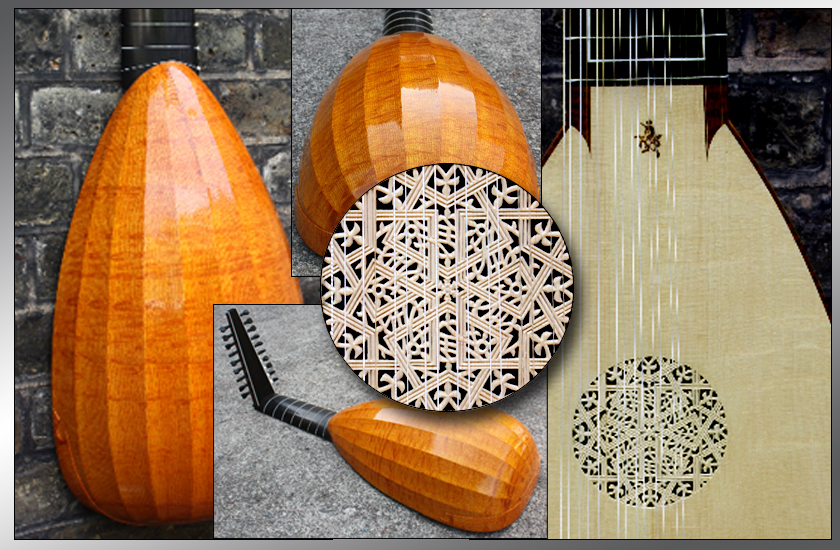
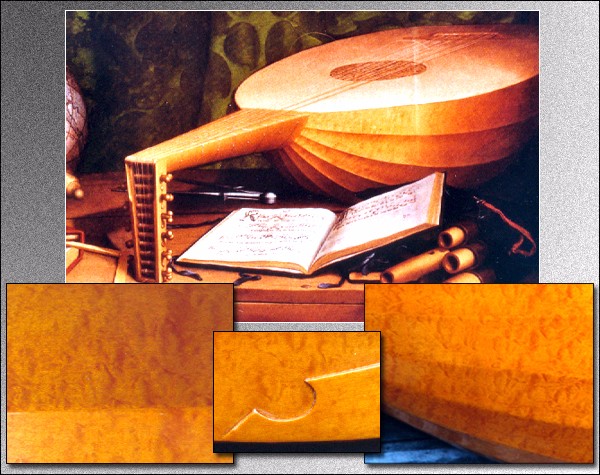

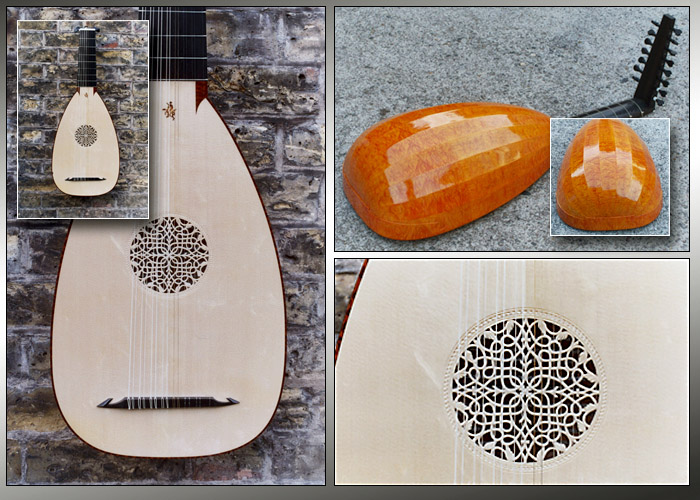


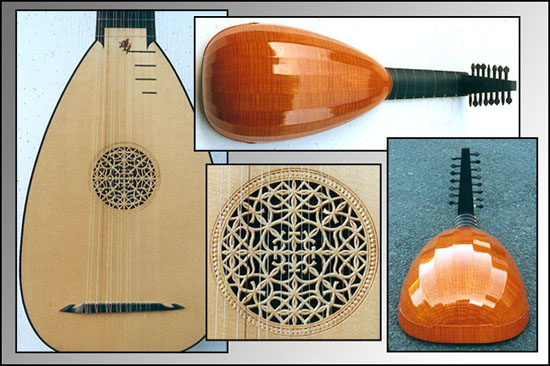
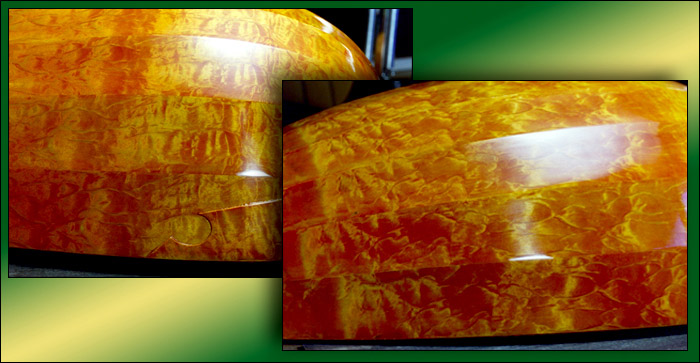

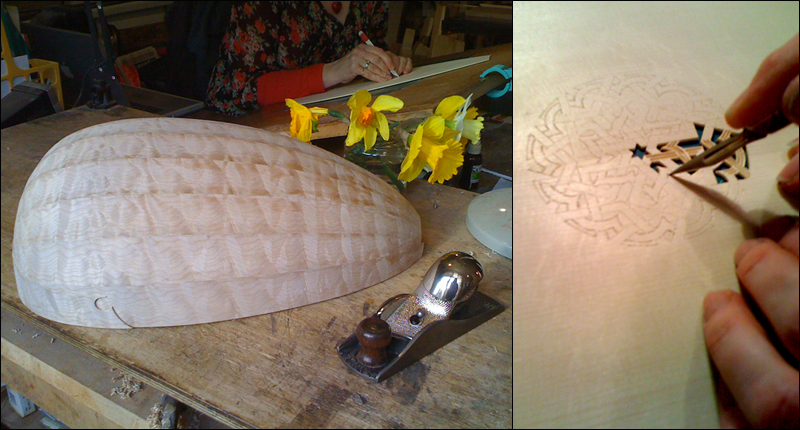

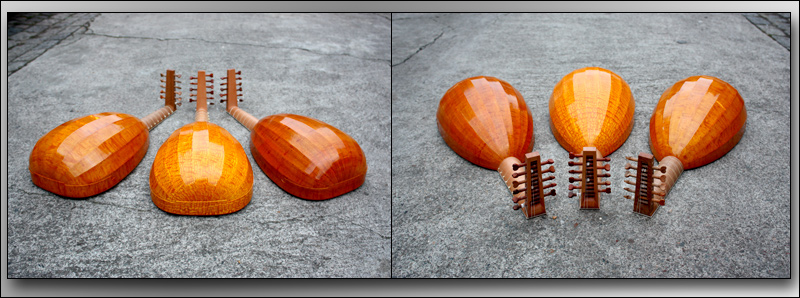

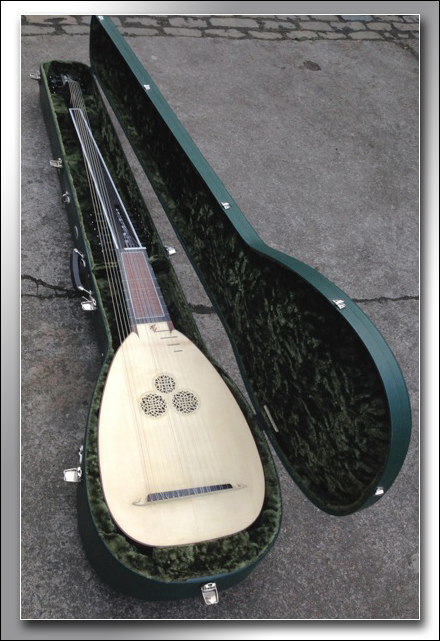
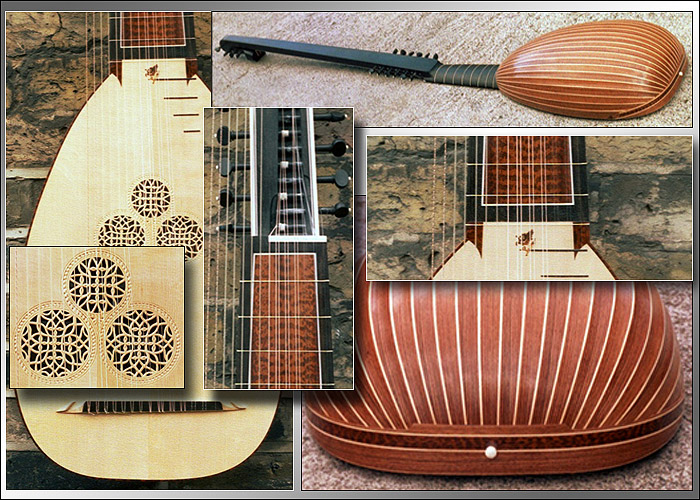

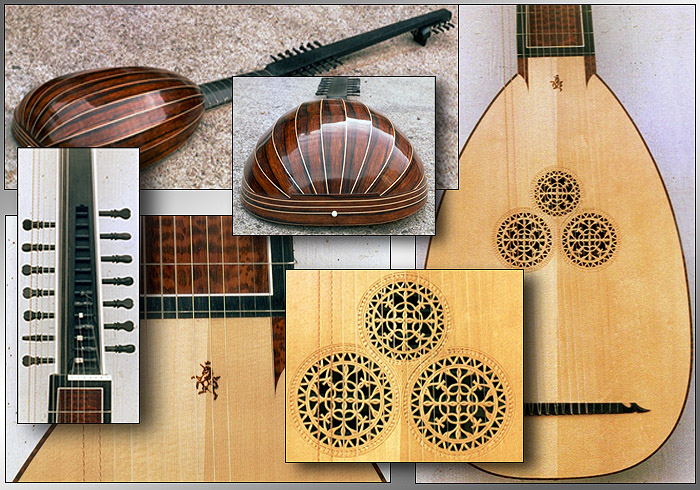


|