 |
||||||
 |
Lutemakers lutes, vihuelas, fluted-back vihuelas, baroque guitars, archlutes, chitarroni, theorbos, orpharions, bandoras, citterns.
England Email: sb.sh@LutesAndGuitars.co.uk
|
 |
||||
|
Welcome to our recently-updated and refreshed website, which was established nearly 20 years ago, having been originally launched in May 1998. Website last updated on Monday 7th August 2017 Lutemakers Stephen Barber and Sandi Harris make a range of instruments of the lute family, including renaissance lutes and baroque lutes, along with archlutes, theorbos, and chitarroni, as well as wire-strung instruments including citterns, bandoras and orpharions. We also specialise in building baroque guitars, renaissance guitars, and vihuelas of all types, including fluted-back vihuelas and guitars – which we were the first modern luthiers to reconstruct and revive. We are in the process of uploading more new images throughout this site (not enough hours in the day, or days in the week . . .). Facebook Page: We launched a business Facebook page in early September 2014, and since then we've been regularly adding images of recent and current new work, as well as what we hope are technically-interesting images of work in progress, our various specialist tools, us working, and short movies; all of which people have often requested: www.Facebook.com/BarberAndHarris There are already links on our Facebook page to short movies that have been made featuring our workshop, and about the Yards where we work in general. The new Facebook page complements our website pages, and we are able to keep it regularly updated, fresh and interesting. Instagram Page: You can now follow us on Instagram: @barberandharrislutes We apologise for the website not having been properly updated regularly during 2016–17, due to factors beyond our control (explained below) triggered by the devastating workshop fire, and sheer pressure of work. Now trending, as it were . . . We wrote here previously about the devastating fire that struck our workshop in June 2014; we'd like to reassure you that we are still in business and operating, albeit at a slower pace than before; here's a brief account of how things have panned out and evolved: In the aftermath of the fire, we were grateful to have received many messages and offers of help, as well as very practical assistance in clearing-up and making-good, from several friends and colleagues, among whom we'd particularly like to thank Lynda Sayce, the well-known theorbo player, expert and scholar, who interrupted a busy work schedule – twice – to spend time helping us here; and also Patrick van der Valk, who drove over from Utrecht to spend a long weekend helping us; he's now an expert in cleaning metal tools corroded by fire extinguisher chemicals, as well as being a computer systems expert. After the best part of six months unable to work properly, we were finally able to get going again. It appears, however, to be the case that several people have wondered if we'd ceased working, or closed-down in the aftermath of the fire; the website having not been updated since March 2016 seems to have added to speculation. What actually happened, according to medical opinion based on numerous tests and evaluations including MRI and CT scans, is that as a result of fighting the fire, surrounded by dense black smoke (the nearby windows couldn't be seen a metre away on a bright sunny day), Steve seems to have inhaled various toxins, which may have caused a severe ongoing balance problem; and a diagnosis of PTSD – triggered by the extreme experience and trauma of 'fight-or-flight' where defeating the furiously-burning fire was concerned . So we had to 're-boot', taking Steve's changed health situation into account. We decided to concentrate on getting up-and-running again, while we worked out how best Steve could adapt, and develop new approaches and methods, given his current ongoing health condition; we're working more slowly, but every instrument we've made since we got started again has been as good as anything we ever made before the fire, and all have been very well-received, from Portland, Oregon to Chattanooga, Tennessee and from Antwerp to Cambridge. You can order with complete confidence, as before. Please read on; we hope you enjoy browsing through our site. And now for something completely different: How about owning and playing a lute 5300 years old . . . sort of: Black (bog) oak – the only native black European timber – was first used by Stephen back in 1975 alongside bone, inspired by the use of the two materials by the Ruckers harpsichord-making dynasty of Antwerp, who used it for their keyboards; this followed a conversation with Stephen's friend the distinguished English harpsichord-maker Derek Adlam, held whilst he was in the midst of conservation work to a Ruckers instrument. At around the same time, Friedemann Hellwig also showed Stephen an original Buechenberg chitarrone lower neck which was veneered with black oak with ivory stripes – suggesting that historically, and at a time and place where ebony was freely available – black oak was considered a rare and precious commodity. We've recently gone a whole stage further and constructed two lutes (an eight-course and a seven-course) whose backs are made from black oak, their fingerboards, pegbox and neck veneers and of course, their pegs, are black oak; images of these instruments appear elsewhere on this site. More will follow in due course. Stephen was the first modern luthier (we'd prefer to use the term 'lutemaker') to use black oak on renaissance lutes in lieu of ebony, but it seems that everybody and their uncle has recently decided to use it. Our current stocks are 5300 years old; this has been dated by Cambridge University, who were provided with samples; the trees from which our timber comes predate the Giza Pyramids, and are more or less contemporary with Stonehenge. How would you like to own a 'New Stone Age' (or Neolithic, if you prefer) lute? From a woodworking perspective, it's an indescribable sensation, running a plane over wood that's over 5000 years old; there's a reluctance to even discard the shavings . . . Across East Anglia, ancient forests of oak, which seemed to have dwarfed modern trees and had a high canopy compared to a modern oak forest, eventually died standing in salt water, and fell into the silt which had once been the forest floor, following the waters of the North Sea having risen to inundate the land of the East Anglian basin around 6000 years ago. Being submerged, the trees were preserved in anaerobic conditions, and were never attacked by woodworm or fungus; many of the trunks which are dug up –typically 2 metres below existing sea levels – are very long and straight, and extremely slowly and evenly grown – comparable in annual ring count and width to the fabled German Spessart oak. The timber, when oiled or polished, has an almost eerie, breath-taking depth of blackness and a sheer presence which ebony simply doesn't possess; and its density – far greater than that of any modern oak species - being very similar to rosewood, means that it is an excellent tonewood which is eminently suitable for lute-making. It's arguably the most exotic European timber (it is found also in the Low Countries and parts of Denmark and northern Germany, where it is known as Mooreiche) and it's not exactly endangered, although, of course, there's a finite amount of it.
The eight-course lute above was made in November 2016 for David Wilson from Boston, USA, now resident and working in Cambridge – about twenty-five miles from where the tree-trunk that yielded the timber we used for its ribs, fingerboard, neck and pegbox veneers, tuning pegs, and half-edgings came from. £6200 as above (£6000 for 7c version) Back to normal service: A baroque guitar in progress:
Above: Sandi working on a version of the 1641 René Voboam guitar; in these images, the fingerboard has not yet been fitted, neither has the distinctive bone & ebony 'chevron' decoration around the soundboard edges and along the edges of the neck. The deep, delicate and complicated parchment rosette (made by Sandi) can be seen, as can the pegbox (constructed from no less than 232 individual pieces, in this decorated version of the guitar – compared with the 3 pieces: core, front veneer and rear veneer – that the basic version of the guitar has). This version of the guitar has ebony side ribs and a 5-rib yew back. Long-established, our combined experience of making the various members of the lute family, vihuelas and guitars like the instrument above exceeds seventy years, during which time we have made around one thousand instruments; Stephen made his first lute – a copy of an original Venere lute owned by Robert Spencer – in 1972, and Sandi made her first lute in 1983, under Stephen's guidance. We went on to form a unique, highly-successful and very efficient equal working partnership, and we usually produce between 15 and 20 instruments between us in a typical year. Our workshop in Peacock Yard in central London was established in 1980. Visiting our workshop We are always pleased to invite players to visit our workshop – we always have a varied and interesting selection of instruments to try. If you want to visit, please email or telephone us first to make an appointment: Telephone: +44 (0)207-703-9978 (workshop/landline). There are many instruments here which we've built and kept as part of our 'collection', including our prototype copy of the Chambure vihuela and the first development 'evolution' version shown above, along with a version tuned in a', as well as a copy of the Koch 1650 chitarrone, a copy of the 6-course Gerle lute, and several 6-course versions of the Magno dieffopruchar lute shown near the top of this page (including this actual lute in its green-painted wooden case) and a 6-course lute tuned in a'. There are, of course, usually several instruments here in addition to these, which will include orders which have just been completed, and also others made by us 'on spec', intended to be offered for sale. We like to place images here from time to time of recent and significant work, so that there is always something new and hopefully interesting for the visitor to this site to look at. Further new images will be posted here soon, meanwhile, immediately below are two special projects, a baroque guitar and a vihuela:
(Photography by Tim Platt, imaging by Richard Harris) The above image shows a vaulted-back Italian baroque guitar – a 'Checchucci' model – that we made for Alex McAllister, a player in Philadelphia (with a detail of its rosette) alongside an exact copy of the famous 'Chambure' vihuela made for the Cité de la Musique, Paris, the owners of the original instrument (E.0748). The vihuela was played for the first time in public by Miguel Henry at a conference which took place at the Cité on Saturday November 27th 2010: Colloque Utopia Instrumentalis: fac-similés au musée Details
of the conference are available at:
Tel: (+33) 01–44–84–44–84 The conference synopsis is: Faits Pareils! Les instruments réalisées par le Musée de la musique à partir de sa collection sont-ils à proprement parler des fac-similés, c'est-à-dire des objets sensés reproduire un original dans tous ses aspects? Que signifie la notion d'original et de copie à un moment où "bien copier" semble à portée de mains ou de technoligie, mais où "que copier?" reste la question à laquelle une réponse univoque semble simpliste. Pour autant, ces réalisations existent dans plusieurs musées et semblent les seules susceptibles d'offrir aux publics un accès à certaines valeurs patrimoniales qu'ils recèlent. Si d'un point de vue pédagogique l'expérience conduite est clairement concluante, l'authenticité y trouve-t-elle son compte? Philosophes, scientifiques, historiens et musiciens partageront leurs points de vue sur cette problématique au cours d'une journée durant laquelle s'entrecroiseront débats et moments musicaux interprétés sur des fac-similés du Musée de la musique. Direction scientifique Joël Dugot, conservateur, Musée de la musique et Stéphane Vaiedelich, responsable du laboratoire de recherche, Musée de la musique.
Above are three views of the copy of the 'Chambure' vihuela (E.0748) which we made in 2010, completed, commissioned by the Cité de la Musique, Paris. (Photography by Tim Platt, imaging by Richard Harris) Its back is made from seven deeply-fluted, double-curved ribs of Jujubier (Jujube wood, Zizyphus sp.); the sides are also Jujube. The neck is cypress (with the neck, heel, internal 'slipper' block and pegbox all carved from the same piece of wood) and all details are copied from the original, using the same materials, dimensions and construction techniques; we were fortunate to find a piece of spruce for the soundboard with an almost identical number of year-rings as the original's, and the Musée staff tracked down the very elusive Jujubier on Corsica. Interestingly, our soundboard reacted and produced an almost identical set of results to the original, when subjected to the tests described in the Cité de la Musique publication: 'les cahiers du musée de la musique 5', "Aux origines de la guitarre: la vihuela de mano", under the heading 'La modélisation par éléments finis' on pages 81 and 82. Two instruments based upon surviving originals in the Germanisches Nationalmuseum (GNM) collection, Nürnberg:
Above: a 6-course Renaissance lute after Laux Maler, made for Craig Hartley, a player in Cambridge, England. This instrument is a reconstruction of the beautiful original Laux Maler lute, MI54, in the Germanisches Nationalmuseum, Nürnberg, and here we have sought to re-create what a typical early sixteenth Century lute might be – with its fingerboard extending onto the soundboard, a plain hardwood (in this case Elsbeere, a native southern German sorbus species, very similar in appearance and properties to pearwood) neck and pegbox, and heart-shaped tuning pegs made from pernambuco. The instrument was strung throughout in gut, and its highly-figured ash ribs are colour-varnished with our own recipe amber-based oil varnish.
Above: a 13-course baroque lute, its body based on another lute in the Germanisches Nationalmuseum collection, MI46, made in Nürnberg in 1744 by Sebastian Schelle; at the request of the player, it was fitted with a triple pegbox. Made for Thomas Zapf, Spardorf, Bavaria. The 11-rib back is made from rosewood with holly spacers between the ribs, and the tuning pegs are plumwood with bone pips. Below are three quite different instruments which give an idea of the range available from our workshop:
Above: at the rear, a 13-course baroque lute after Sebastian Schelle, 1744 which was made for Bob Venning, in NSW, Australia; in the centre a liuto attiorbato based on instruments by Matteo Sellas (this version has engraved mammoth ivory fingerboard panels) which was made for Noboru Kaneko, in Sapporo, Japan; and a vihuela which was made for Eligio Quinteiro, a Spanish player based in London. Bob wrote: "Many thanks to you both for such a beautiful instrument". Noboru wrote: "My liuto attiorbato is a superb instrument; I cordially thank you for building me such an instrument; the instrument is very beautiful and attractive for me". Eligio wrote: "The vihuela is the best I have ever played – truly. I have recommended it to my friend Jesús and another performer who is looking for one at the moment. Thanks for such wonderful instruments; you'll always have my respect and admiration". Below is a composite image of a thirteen-course baroque lute, one of a pair of triple-pegbox instruments we made: one was a customer's order, the other (shown directly below) was made 'on spec' and offered on the 'For Sale' page of this website, and subsequently sold: Instruments available for sale now
Above: a thirteen-course triple-pegbox baroque lute after Johannes Jauck, Graz 1734, completed in July 2007. It has a 15-rib back made from figured maple, unstained plumwood pegs (with bone pips) and an ebony-veneered neck. The pegbox is made from maple, and stained black. The lutenist who we built one of these lutes for (it and the instrument shown above were completed back-to-back) Rob Parisien, of Cape Elizabeth, Maine, sent us this email upon receiving his new instrument: "YES!!! It is here! and I love it! I am completely blown away by the construction and craftsmanship. What a work of art! Beautiful in every detail. You have easily surpassed my very high expectations. First of all, the lute plays very well, it is much easier to play than my current baroque lute. The action is perfect. I have tuned it up to 415 and it has the most beautiful delicate sound and overtones – and that is only after the second day and the strings haven't yet settled down. If I push it I can make the long basses thunder – I can feel it in my chest when I play. Exactly what I was looking for. Thank you so much for making such a work of art. It is worth twice the price. Please take pride in the fact that you have made my life better by giving me such a work of art. Thank you for doing what you do. I am extremely grateful. Sincerely, Rob Parisien". Rob's lute is shown in the image below, alongside a bassrider thirteen-course. The two triple-pegbox lutes in the images above and below may at first glance seem to the same instrument; this is because the maple used for their backs came from the same plank of timber; the instrument shown above had a longer stopped string length than the one shown below, hence its having 9 tied frets on its neck, whereas the lute below has 8 tied frets.
Above: two thirteen-course baroque lutes; the one in the foreground has a stopped string length of 700mm, and a 15-rib back made from figured maple, which has been varnished with a tinted oil varnish; it is based on an original instrument by Johannes Jauck, 1734. The instrument behind it is based upon the 1744 original by Sebastian Schelle, and its 11-rib back is made from rosewood, with holly spacers between the ribs; its stopped string length is 730mm. Some perspective distortion has been produced by the 35–70mm Nikkor zoom lens used to shoot this image, as the bodies of the two lutes are in reality very similar in size.
Above: a thirteen-course swan-necked Baroque lute we made in September 2005, for Taco Walstra, of Hilversum, Holland; it is based on an original lute by Sebastian Schelle (Nürnberg, 1744) and has a Rio rosewood back, and the rear panels of the pegbox are carved and pierced, the design taken from a similar instrument by Leopold Widhalm, 1755.
A seven-course Renaissance lute we made in 2003, based upon the Hans Frei C34 lute in the Kunsthistorischesmuseum, Vienna; it has an 11-rib back from highly-figured birds-eye maple and an ebony-veneered neck and pegbox. Website last updated on Monday 7th August 2017 Our website will in future be updated and modified frequently, with new images and information being added continuously. However, in order not to oblige the visitor to this site to have to download too many large files, we show only a very limited selection of images of our work here. Having said that, we realise that people like to be able to view a good selection of a maker's work, and we are thus engaged in an ongoing process of introducing new images to replace some of the older ones; these will be available here on the website as they are produced. They will perforce include several interesting new instruments built in recent months, as well as older favourites. Images are placed throughout the site, and there are further images in the Gallery section: Throughout the Catalogue sections of the site, you can find further images of our work; following this link, you can find and browse through the various sections covering the different types of instrument we make, using the navigation bar at the top of this page: We also now have, since September 2014, a business Facebook page, where we will be regularly posting images from the workshop of current instruments and our latest projects: www.Facebook.com/BarberAndHarris A feature of the site we have been developing and expanding in recent years has been to introduce some biographical details and historical notes pertaining to some of the illustrious old instrument makers whose original instruments we work from and who inspire us, along with extracts from some of the old writers and commentators on the lute, guitar, vihuela and related instruments, and relevant illustrations and other iconography; we hope that you find this information as fascinating as we do, and worthwhile reading. The section on the Fugger banking dynasty of Augsburg is an example of this approach: given the important historical relevance of the Fuggers as patrons of the arts, not least their close involvement in the musical life of their times, we thought that it would be interesting to place some of the research and background information we've accumulated, using as our starting-point the famous inventory of lutes owned by Raymund Fugger (1489-1535) compiled in 1566. This account can be found on the Catalogue 2011 page of this site, which contains comprehensive lists and full details of the instruments we are currently offering, many of which are illustrated: And following several requests to do so, we've also posted several scans taken from Thomas Mace's Musick's Monument (printed and published in London in 1676) in those parts of the website where he has been quoted, so that readers can get a 'feel' of his original text as it appears on the page, and the lettering and spellings he was using. Examples can be found, for instance, in the page on Six-course Lutes: Para ver la pagina en Español: The Catalogue pages of this site have been translated for us into Spanish by Ariel Abramovich. Availability Our waiting-list is at present (August 2017) just over 14 months long. However, we deliberately reserve a limited number of regular 'gaps' for players who want an instrument reasonably quickly – please feel free to ask us for up-to-date details of what's possible, we can usually help you. Working together enables us to build instruments that are available for immediate sale, which is popular with players who do not want to be put on a waiting-list which can be frustratingly long, and are keen to acquire an instrument sooner. As well as working to commission, because there are two of us, we are able to build during the course of the year a number of instruments which the player can buy straight away – these will typically include popular models such as 6, 8 and 10 course lutes, 13-course bass-rider baroque lutes, French theorbos, and baroque guitars: Instruments available for sale now Our workshop has been offering this facility since 1990: the 'For Sale' page of the website is not a case of having the odd instrument for sale here and there, it is a carefully considered and integral aspect of our production.
The 5-course guitar shown above – based on an original by Alexandre Voboam, 1680 – is one of the models that we regularly build and offer for sale during the course of the year (we usually manage to fit-in at least three of these guitars per annum, as well as several lutes); these 'on spec' instruments are made in addition to our list of orders and commissions, and fitted-in between them, for the benefit of players wishing to acquire an instrument relatively quickly. For further details, please follow this link: Instruments available for sale now Broadcasts, recordings & performance We make lutes, vihuelas, baroque guitars and continuo instruments not only for leading professional players, but also for beginners, students and amateur players world-wide; our instruments enjoy professional use worldwide in concerts and radio and television broadcasts, and are featured on numerous CD and other recordings. Our instruments – closely-based on historical examples – are renowned for their build and design qualities, their clear, well-balanced and powerful tone, quick response and articulation, and ease of playability. They have been ordered by many distinguished players, including: Sven Åberg – Ariel Abramovich – Ron Andrico – Mitsuru Ayatani – Paul Beier – Thomas Binckley – Jim Bisgood – Gary Boye – Julian Bream – Bruce Brogdon – Elizabeth C.D. Brown – Jürgen de Bruin – Michele Carreca – Victor Anand Coelho – Antonio Corona-Alcalde – Andrea Damiani – Beate Dittmann – Martin Eastwell – Kasia Elsner – Christoph Eglhuber – Ben (Wezi) Elliott – Charles Edouard Fantin – Mike Fentross – Eugène Ferré – Tom Finucane – Dirk Freymuth – Christine Gabrielle – Negin Habibi – Lucas Harris – Vanessa Heinisch – Jacob Herringman – Thomas Höhne – Scott Horton Robin Jeffrey – Edin Karamazov – Leif Karlsson – Hans-Michael Koch – Richard Labschütz – Esteban La Rotta – Jakob Lindberg Rolf Lislevand – Andrew Maginley – Wim Maeseele – Philippe Malfeyt – Mark Mancina – Alfonso Marin – Markus Märkl – Holger Marschal – Will Mason – Hållbus Totte Mattsson – David Miller – Pascal Monteilhet Michiel Niessen – Nigel North – Paul O'Dette – David van Ooijen – Franco Pavan – Radamés Paz – Barrington Pheloung – Pierre Pitzl – Eligio Luis Quinteiro – Keith Richards – Sigrun Richter – Kenji Sano Jordi Savall – Lynda Sayce – Andrea Sechi – Paul Shipper – Denys Stephens – Stephen Stubbs – David Tayler – Francesca Torelli – Taco Walstra – William Waters – Arto Wikla – Christopher Wilson and numerous other leading players worldwide. They can be heard on recordings by, amongst others: Tragicomedia – The Dowland Consort – The Lute Group – Hedningarna – Boston Baroque The Sixteen – Hespèrion XX – Circa 1500 – New London Consort – The English Concert The Academy of Ancient Music – L'Ayre Español – Les Arts Florissant – English Baroque Soloists – Le Concert des Nations The Kings Consort – The Harp Consort – Concerto Palatino – Les Trésors d'Orphée – Teatro Lirico Ensemble Kapsberger – La Capella Reial de Catalunya – Il Fondamento – La Venexiana – I Fagiolini – Zefiro Torna
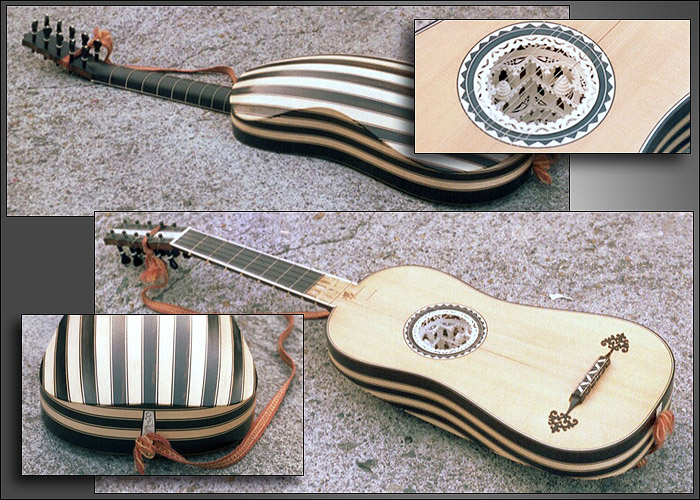
A five-course baroque guitar we made in 2003, after an original guitar labelled "Jacopo Checchucci in Livorno 1623. Its vaulted back has 17 fluted ribs, in ebony striped with ghostly-white holly; it has a six-tiered parchment rosette. An instrument that earns its keep, it is owned by Jim Bisgood, one of the musicians of the Globe Theatre, London – where it has been played many times.
The deep, six-tiered parchment rosette of the baroque guitar shown above.
Both the carved lute rose and the parchment baroque guitar rosette shown above were made by us, working from original measurements and close-up photographs we took (in the case of the guitar rose, from a technical drawing of the guitar which was commissioned from Stephen in 1980 by The Ashmolean, Oxford, in whose collection the guitar resides). We don't outsource the making of our lute or guitar rosettes, and they are not laser-cut; they are all individually made by us using traditional techniques and tools. Left-handed versions of all the models listed on this website are available, at no extra cost; shown here is the pegbox of a 13-course baroque lute, built for a left-handed player:
The pegbox of a left-handed 13-course baroque lute, based upon instruments by the great Nürnberg lute and violin maker Sebastian Schelle. The 'dolphin' treble rider shown here is on a left-handed version of this 13-course that we made in August 2004 to special order; we don't charge extra for making left-handed instruments, and in fact over the years we've made a significantly large number of instruments for left-handed players. The pegbox cheeks are veneered with snakewood, and the black-stained plumwood pegs have bone pips and finials (on the bass and treble riders). All of our instruments are brandmarked with either Sandi's Pegasus mark:
or Stephen's Unicorn:
The brandmark is usually lightly burnt into the soundboard of lutes, vihuelas and guitars at the top end, near the body frets, although sometimes it is burnt into the endclasp or the front or rear of a guitar or vihuela pegbox. Some instruments have both marks – such as our series of fluted-backed vihuelas based on the Chambure instrument, one of which is shown below. A six-course fluted-back Vihuela
We were the first modern workshop to revive the art of making fluted-backed guitars and vihuelas; Stephen made copies of the Belchior Dias 1581 guitar back in 1976 whilst drawing it for publication, and we made our first copy of the Paris 'Chambure' vihuela in April 2001. In recent years we have both worked together on a number of vihuelas and guitars derived from the original Dias guitar and the unsigned Paris vihuela. The vihuela shown above – which was the first of a matching pair made in late 2004 – is a scaled-down, 'Evolution' version of the Paris Chambure vihuela; it was also built with reference to the 5-course 1581 guitar by Belchior Dias, but deliberately made wider and deeper. Its string length is 540mm; it is made from highly-figured mahogany, with a cedrela neck and pegbox, pernambuco pegs, a figured afzelia fingerboard edged with bone, and bone inlays and detailing; its rose is cut into the soundboard, with parchment detailing behind. This first one was sent to a customer in Kansas City, Doug Goodhart, who emailed us after experimenting with different strings, saying: " The vihuela is sounding great. It has very good projection and a warm, clear and lovely tone. In short, your vihuela is everything I had hoped it would be and we are getting along quite well. Everyone who hears it thinks it has a strong, lovely sound. The music community here is fully impressed. Thanks again for a wonderful instrument and all the best ". The second of the matching pair we keep in the workshop as part of our permanent collection of instruments, so that it is here for visitors to try, and is also available for us to show at exhibitions. A 6-course lute, an ebony version of the famous ivory original by Georg Gerle We regularly publish on our website a selection of images of instruments we've built; this is Sandi's version of the Georg Gerle lute, made in April 2005; it has an ebony back and neck decoration (inverting the ivory of the original). Further down this page, there's an image of the original lute being measured by us in the Vienna Kunsthistorischesmuseum, the collection which owns it.
The instrument shown above (which was made for Simon Lilley, of Bolton, Lancashire) has a back made from ebony, with holly spacers; its neck, pegbox and fingerboard are veneered with ebony with bone edgings, and the rear of the neck has two inlaid green horn stripes; the heart-shaped pegs are in ebony and pernambuco. Shown (above, left) for comparison with a version we made in 1993 (for the late Ruth MacIntyre, of Stockwell, London, who studied with the late Tom Finucane) which has a colour-varnished back made from figured ash, and a neck & pegbox veneered with mammoth ivory. The two lower images above were taken before the frets were fitted, in order to more clearly show the dramatic contrast between the deep black ebony and the mottled green horn to best effect. The original Gerle lute has a back made from ivory ribs, and its neck, pegbox and fingerboard are veneered with ivory; there are images of it being measured a little further down this page. Two baroque guitars (copies of instruments originally made in Cremona in 1700, and Paris in 1641) and a fluted-back vihuela.
The composite image above shows a copy made in early 2004 of the 1700 Stradivari guitar (made for baroque guitar expert Gary Boye) alongside a copy of the 1641 Voboam guitar we made several years ago – since sold to Keith Richards (yes, that one); the same Strad guitar is also shown in the upper part of the image next to one of the recent fluted-back vihuelas tuned in a'. The Voboam guitar and the vihuela are kept here in the workshop as part of our collection of instruments, and are of course available for visiting players to try. Working from original instruments: We have built up over the years a considerable and unique archive of research and documentation of surviving original instruments in both public and private collections across the globe. We would thus describe our work as lutemakers as an ongoing, organic and symbiotic process of building new instruments for the modern player, based upon this extensive and ever-growing resource, whereby we feel reasonably confident that we are building instruments which closely reflect the spirit and style, as well as constructional details and materials, of the old masters.
This image shows the very first modern copy of the unique Magno dieffopruchar six-course lute (from the Charles Beare collection, London) which was built by Stephen in May 1981 – side-by-side with the original lute, for exact reference – which was open, being measured & drawn by Stephen in our workshop. The model shown above – which was originally built as one of a matching pair – has a rio rosewood back with mammoth ivory fillets between the ribs (the original lute has an ivory back with snakewood fillets) and a neck, pegbox and fingerboard veneered with mammoth ivory, and bone pegs. Interestingly, it took less time to make than its wooden case. Stephen found himself making several of these cases in the late 1970's, and working together we made a few more in the early 1980's – mostly for medieval lutes and 6 course lutes. The image on the left shows the case hanging on a wall, with the lute resting in it, just as a large number of 16th and 17th Century paintings depict; the size and shape of the pegbox part of the case is dictated by the arc through which the lute moves when it is lowered into it – and once safely in the case, the lute tends to rest leaning slightly forwards – a nice way to display the instrument when not being played. The exigencies of modern life, wherein the majority of lutenists will want a case that is both waterproof and resistant to being knocked about, meant that the players we built these cases for used them for the most part as an attractive way of displaying the lute at home (or in the context of a performance) with another case being used to actually transport the instrument through the streets. Ruefully, it has to be admitted that, although making such a case – similar to those seen in many 16th Century paintings, woodcuts and engravings – seemed like an interesting project at the time, it turned out to be far more time-consuming than the lute it contains. Its lid is lined with marbled paper (made by a friend who is a conservator at the National Gallery, London) the interior is lined with green felt to protect the lute's body, and it looks nice hanging on the wall – as often depicted in paintings – but please don't ask us for one of these cases, as it'll cost more than the lute! |
||||||
|
Research and measurement: a unique archive and resource Our work is based on extensive personal research, which is ongoing with frequent visits to museums and private collections, continually expanding our unique archive of information and measurements of original instruments. This archive is reflected in the range and quality of the instruments we offer, and means that we do not have to rely on published drawings for our information and knowledge. For us, researching original instruments and making modern copies is a natural, logical and seamless process; it's what we do: in recent years, additions to our repertoire based upon our research have included the 'Chambure' vihuela in Paris (shown further down this page) and 'Evolution' versions of it (also shown on this page). During a very interesting journey across Germany in October 2001, we measured the large 6-course lute by Friedrich Prÿffer in the Wartburg, Eisenach, the 5-course baroque guitar by Antonio Mariani in the Leipzig Musikinstrumenten Museum and the 12-course lute by Wolfgang Wolf in Füssen. The Cassas Baña guitar – a rare example of a late baroque guitar from Catalunya – was documented following a visit to the Brussels MIM collection, in August 2002. Measuring trips have continued throughout 2002 – 2013, up to and including the Autumn of 2014.
The X-ray image above – courtesy of Klaus Martius at the Nürnberg GNM – shows a very interesting and hitherto-unsuspected aspect of 16th Century lute construction: see if you can spot it . . . (clue: it isn't the vertical structure to the right of centre, which looks suspiciously like a rendition of the citadel at Isengard). Documentary technical drawings Stephen has, over the years since 1976, made documentary technical drawings – commissioned by major museums for publication – of several important instruments, including the earliest surviving guitar – Belchior Dias (1581); the best-preserved examples of guitars by Antonio Stradivari (1688) and René Voboam (1641); the 'Rizzio' guitar, originally thought to be the work of Jean Voboam, but recently attributed to René Voboam, c. 1680; a liuto attiorbato by Christofolo Choco (c.1630); the 'Urbino' cittern (Augustus Citaraedus, 1590) and the very important 6-course lute by Magno dieffopruchar (Tieffenbrucker, c. 1560) as well as important viols by Barak Norman, Richard Meares and Michel Colichon. These drawings are available from the museums and private collectors who own the original instruments, not from us; please enquire for details if you are interested. Measuring and photographing the Martin Selos lute in the Germanisches Nationalmuseum, Nürnberg, October 2004 & January 2005 We are often consulted for an opinion on an old instrument; to give an example, this happened in Nürnberg at the Germanisches Nationalmuseum in October 2004 and January 2005, when we were invited by Klaus Martius to examine with him an ivory lute labelled 'Martinvs Selos Germanvs a Venetia', which may well have been originally built as a 10-course (it is dated 1647 – or 1649 – the final digit is ambiguous). Normally hidden away in the Museum's depot, this instrument – although lacking its rose – is a finely-proportioned example of a Venetian lute from the middle of the 17th Century; it has a flattened back profile with 15 ribs, reminiscent of Bologna lutes; it had been converted (probably to an 11-course configuration) in 1709 by Wenger in Augsburg, and its most recent incarnation was as a 'guitar' following a crude conversion. We were so inspired by this beautiful fragment, that we are planning to make either a 9 or 10-course version of it when we can find the time, probably made from either heartwood yew or shaded yew, at 67cms string length; the instrument would also, of course, work as a very well-proportioned 11-course lute – which seems to be how it was re-built by Gregori Ferdinand Wenger in Augsburg (before being subsequently rather clumsily converted for use as a guitar). In January 2006 we looked again at this beautiful fragment at the GNM, at the invitation of Klaus Martius; we jointly came to the conclusion that the guitar neck seen today is probably the remnant of the conversion by Wenger to an 11-course disposition: the nail through the existing neck-block – as seen in X-ray images – has never been disturbed, the guitar neck seemingly carved from the earlier 11-course neck (which does not seem to have been veneered in any way, but probably painted and/or stained – a practice as commented upon by Mary Burwell in 1660). This would produce a mensur of approximately 720mm, given the length of the surviving Wenger neck fragment; the evidence presented by the top end of the soundboard of the instrument points to its having been fitted with a far wider neck than any gallichon would have had – clearly implying a probable 11-course conversion by Wenger. Klaus restored the lute's beautiful ivory back, working from 2013 into 2014.
The composite image above shows Sandi using our Mac G4 Powerbook, documenting the Selos lute during our visit to the GNM on October 15th 2004; we measured its back during a return visit on January 28th 2005 using the device shown in the image below.
Measuring the Georg Gerle lute in Vienna, January 2002 In January 2002, we returned to the Vienna Kunsthistorisches Museum and Nürnberg Germanisches National Museum, and re-examined in great detail the Georg Gerle and Laux Maler lutes held in these collections, using our unique system for accurately measuring lute backs. The composite image below shows the Gerle 6-course lute – one of the jewels of the Vienna KHM collection – being measured by Sandi during our visit; she is adjusting the sliding boxwood probes.
This specially-designed machine (the design and concept of which enjoy design registration copyright protection) which we developed and built in 1986, allows us to measure an old lute back of any size, from the smallest soprano lute to the largest chitarrone – whether it has 9 or 65 ribs – with effectively 100% accuracy; it also works on vaulted-back guitars. In conjunction with our other measuring equipment, we've used it all across Europe, from Stockholm to Rome, from Barcelona to Vienna, and of course here in London, measuring dozens of lutes, archlutes, chitarroni, theorbos and guitars, in public and private collections.
Above: one of the fruits of our research next to its inspiration: the set of images above shows a copy of the Gerle which we made in 1993 (with a back from figured ash, its neck veneered with mammoth ivory and green horn) alongside the original ivory-backed Gerle lute. These photos were taken in January 2002 when we re-measured and photographed the Gerle in the Kunsthistorischesmuseum, Vienna; these are genuine images, not produced in Photoshop. Travels across Europe . . . Often we will load our Seat Alhambra and travel to measure and photograph an instrument which simply intrigues us, or because it is unusual: the Antonio Mariani guitar of 1680, in the Leipzig collection was a typical example, which we measured in October 2001 (it is very unusual in that it seems to have originally been built as a vaulted-back guitar which was later converted to a flat-back type). It has a very interesting and unusual rosette, and we currently have a prototype copy underway which we plan to have ready soon (see Cat 11, No.19 for further details). In January 2004, we measured and photographed the 1734 Johannes Jauck 13-course triple-pegbox baroque lute in the Vienna Kunsthistorisches Museum and we have subsequently developed a slightly reduced verson of it (please refer to Catalogue 7 [No. 6] for further details). An exciting opportunity arrived in March 2004, when we were asked to examine a previously unknown lute by Laux Maler which had turned up; this was a very timely event, as it usefully preceded another research trip in June 2004 to look at the two well-known Maler lutes in the Czech Republic (see below). We went back to Nürnberg in early November 2005 and again in January 2006 to have another close look at the 1721 swan-necked 13c lute by Sebastian Schelle, and various guitar rosettes; we returned to the GNM in January 2008 on our way back from Vienna, to further document the Selos and Maler lutes. The year 2008 was on the one hand a very busy year for us, and on the other a difficult year, overshadowed by a serious accident which Stephen sustained using a bandsaw; recovering from this accident meant that the time available to us to travel and do research work was severely curtailed, and further measuring trips had to be shelved until 2009. The Lobkowicz collection Laux Maler lutes The following piece was written and published here on our website some time before the 1999, Volume XXXII Journal of the American Lute Society was published; we only comment on this because there is an article in this ALS Journal which refers to these instruments. Our observations – following our visit to examine the two Maler lutes in June 2004 – were written-up and published here in July 2004, clearly quite independently of the article in the Journal, which we were first shown by Klaus Martius in November 2005, he having then recently received that edition, then the most recent ALS Journal. Examining significant original instruments continued apace in 2004: and our long-standing desire to properly examine the two Lobkowicz Maler lutes culminated in one of our most satisfying and exciting research visits ever: a journey to Nelahozeves Castle, north of Prague, on 2nd June, the home of the Lobkowicz family. We took time out following the Regensburg Tage Alter Musik exhibition to drive to the Czech Republic and spend some time there, and subsequently made the journey to Nelahozeves, by the Vltava river, north of Prague. The castle – built mostly by Bonifat Wohlmuth, commencing in 1553 and finished in 1614 – was bought by Polyxena Lobkowicz for the Roudnice Lobkowicz family in 1623. Ferdinand August – 3rd Prince Lobkowicz – was an accomplished lutenist, and his son Philip Hyacinth Lobkowicz, the 4th Prince Lobkowicz (1680-1734) was also a distinguished lutenist and a composer; Philip Hyacinth Lobkowicz was in contact with the composer Arcangelo Corelli (to whom he was a patron) and – very significantly for our interest in the Maler lutes – Sylvius Leopold Weiss. He appointed Weiss as music teacher to his wife Anna Maria Wilhelmina von Althan, to whom Weiss dedicated several works. The two Malers – which we knew from old measurements and photographs taken under difficult circumtances in the mid-1970's – were converted to 13-course configurations by Thomas Edlinger of Prague, in c. 1700 (the label in one of the instruments is ambiguous) and 1705. It is believed that the Lobkowicz family archives – restored to the family's possession since the fall of communism – may well contain information pertaining to their purchase and use. It would be of immense significance if a link with Philip Hyacinth Lobkowicz, the 4th Prince Lobkowicz, or even Weiss himself, could be discovered. The opportunity to properly examine these very important lutes (and measure the geometry of their backs using the machine shown further down this page) was something we had been anticipating for some time. With all of this focusing our thoughts, it was quite a moment – and one which stirred the emotions, knowing the lute's historical context which surrounded us: driving our Seat Alhambra across the arched stone bridge and into the courtyard of Nelahozeves Castle, one of the most important Renaissance buildings in Bohemia, to unload our measuring and photographic equipment. It was in every sense an honour to be invited to examine the Maler lutes, which have been in this family – a lynchpin of musical life in Bohemia – for many generations. An added frisson was provided by being able to leaf through original lute manuscripts by Jacques de Saint Luc, Charles Mouton and Jacques Gallot – which of course provided context for the lutes themselves.
Nelahozeves Castle in 1841, by Carl Robert Croll. We would recommend anybody with even only a passing interest in art or music to visit this place: art lovers will stand transfixed before works by Rubens, Breughel the Elder, Cranach, Velásquez and Veronese; Londoners will be delighted to experience two paintings by Canaletto, hung on opposite walls, showing views of London from the river; as Londoners ourselves, we were spellbound. The very knowledgable staff are very friendly and helpful. website:
www.lobkowicz.org Fluted-back Vihuelas Images of new models and recent instruments are added to the site on a regular basis, such as the fluted-back 'twin' Vihuelas shown further up the page and below, which were made in the autumn of 2004; tuned in a' – both made with double-fluted ribs acanalada e aconvada (also known as tumbada in the old sources). They are a matching pair, their side and back ribs, necks and pegs being made from the same timbers; the principal difference between them being that the first version – ordered by a player in the US – has a cut-in rose and the second an inserted wood & parchment rose. Leading vihuela specialist, Sevilla-based Argentinian virtuoso Ariel Abramovich played the second version of this instrument, along with the larger 'Evolution' version at a recital he gave during the Open Studios event at Peacock Yard during the first weekend of December 2004 (images of that instrument are shown below, further down this page). His programme included pieces by Francesco, Narváez, Daça and other composers. Christmas and Summer Open Studios Weekends Further details about Open Studios / Christmas and Summer Sale events in Peacock Yard, Iliffe Yard and Clements Yard are available on the Yards' website: Around forty workshops and studios are open – usually over the first weekend of December, exhibiting and selling the work of around sixty artists and designers; glassware, jewellery, fashion, silverware, ceramics, graphic design, photography, porcelain, architecture, metalwork, product design and of course lutemaking are among the activities on show. The summer sales usually take place over the first weekend of July. At the 2004 and 2006 events, we had a jazz/funk gig on the Friday evening at 8.30, the four-piece band led by Pete Oxley, one of the UK's best jazz guitarists (as well as being one of the best modern violin-bow makers around). The 2005 musical events were unfortunately cancelled due to illness, but went ahead in 2006. The event planned for 2007 didn't happen because we were too busy to participate, although we opened the workshop to the public in subsequent years, and interestingly in 2011, we received an order for a student lute from a lady who had visited us several times previously, and who had become fascinated with the idea of learning to play the lute. The 2014, 2015 and 2016 Christmas events took place during the first weekend in December, and Ben Elliott, a young up-and-coming lutenist, a graduate of the Royal College of Music, London, was on hand each year, playing throughout the weekend. In recent years we've all been running a Summer Open Studios event too, during the first weekend of June; as well as delicious food on offer from Piccallili Cafe, local micro-brewery Orbit Beers sell a range of excellent, refreshing beers: a perfect weekend out, all in all. The 'Chambure' Vihuela Since being re-discovered by Joël Dugot in 1996, this landmark instrument had languished in anonymity for a few decades since it had been the subject of correspondence between Geneviève Thibault, Comtesse de Chambure, and Michael Prynne of the Lute Society. It was packed away in a box in the museum depot, and it was only when it was found by Joël during the course of going through the reserve collection (as the exhibits for the new Cité de la Musique collection were being selected) that he brought it out of obscurity and to the excited attention of those of us interested in the vihuela and its history. Here at last we had a new instrument to refer to, which would make us all reconsider our thoughts and beliefs on the organology of the vihuela. Because of Stephen's familiarity with, and expertise regarding the 1581 Belchior Dias five-course guitar in the Royal College of Music, London (RCM 171) which he had made full-sized documentary technical drawings of back in May 1976, Joël invited us to visit Paris and examine and discuss together the recently re-discovered vihuela; it was immediately obvious that here was a vihuela that was the product of the same school of building that had produced the Dias guitar. Shown below is a close copy – indeed the first proper modern copy made of this instrument, which we finished in May 2001 – of this Paris 'Chambure' vihuela, with its unique double-bent rib back construction. We were the first modern luthiers to properly measure and photograph the instrument, when it was open in April 1999, there being no museum drawings available at the time; and we were the first to develop a simple, reliable and consistent technique for double-bending its back ribs – via our own efforts and initiative, and working independently. This vihuela – our first copy – has Cuban mahogany back and sides, a one-piece neck and pegbox carved from cypress, a wood and parchment rosette, and a 646mm string length. We first exhibited it at the Regensburg Tage Alter Musik festival in May 2001, where several players, including the Mexican vihuela virtuoso Eloy Cruz, were very impressed by its clarity and immediacy; a few months later, at the Berlin exhibition, Dutch player Mike Fentross – a specialist in Iberian music – was unable to put it down.
For further details of the instrument shown above (the example shown here being our prototype, built between April and May 2001) please see No.5 of the Vihuela section (Catalogue 12) of the 2004 Catalogue on this site. As well as receiving orders from players worldwide, we were commissioned to build a copy of it for the Paris Cité de la Musique – the owners of the original. This commission is part of their enlightened policy of having a selection of accurate copies made of star items from their collection which can be played. The instrument was duly completed and delivered, and the player who gave the first recital upon it – Miguel Henry – announced that he was absolutely delighted with it. It was strung throughout in gut, of course. The instrument was delivered to the Musée in August 2010, and it featured in a conference held at Cité de la Musique on November 27th 2010, where it was played in concert, the first of many. Images of the instrument made for the Musée can be seen near the top of this page. Our colleague and friend, the Berlin viol maker Tilman Muthesius, made for the Cité de la Musique a copy of the 1683 bent-front gamba by Michel Colichon in their collection; there is an interesting personal connection here, because more than 20 years ago, when Stephen was exploring with Dietrich Kessler how such bent fronts were made, the 1691 Colichon viol belonging to Dietrich was the subject of much fascination for Tilman, who – having been shown by Stephen the early draughts of the drawings of Dietrich's viol which he was working on at the time – then set off to measure all of the existing Colichon instruments. It's nice to see one of the fruits of all that work in the instrument Tilman has made for Cité de la Musique. We had been working on a copy of their vihuela since late 2009. We are also responsible for everybody now referring to it as the 'Chambure': we were the first to name it thus – here on this Website – in honour of its illustrious previous owner, the very wonderful but sadly late Geneviève Thibault, Comtesse de Chambure. Our prototype copy of the Chambure vihuela has been now strung and played for nearly fifteen years (and for most of that time with gut strings) and it continues to mature and develop; its structure remains absolutely stable, its action has never changed and it hardly ever needs tuning (the latter thanks to Nick Baldock's excellent Kathedrale gut strings). When first strung, it far exceeded our hopes and expectations, and continues to develop, and we've been able to show it to vihuela players across Europe and in Mexico, alongside the 'Evolution' and a'-tuned versions we've developed and built (the second type – string length 590mm – is shown below, and a version in a' at 540mm is shown further down).
The instrument shown above – the double-bent ribs of its back made from 7 consecutively-sawn slices of highly-figured walnut – was the first of our 'Evolution' versions of the original Chambure vihuela; its ribs were made with deeper fluting than the original instrument's. Although it is smaller than the Paris original, it retains all of the aural and tonal 'presence' and projection of our copy of the original; it has a string length of 590mm, thereby making it ideal for the more demanding pieces in the repertoire. For further details, see No.5 of the Vihuela section (Catalogue 12) of the 2009 Catalogue on this site. We had started work in May 2003 on development of this 'Evolution' model of the Chambure original, with a shorter string length, and a smaller, narrower body but with the same deeply-fluted, double-bent back rib construction. Although its completion was delayed by pressure of work over the spring and summer months of 2003, we finished it in time to show this new instrument at the Utrecht Festival Oude Muziek in late August, 2003. It was played to great acclaim by Michiel Niessen at the Stage on the Saturday afternoon, jointly presented by Stephen and Michiel in the Vredenburg Kleine Zaal; Michiel was astonished at how stable it was, having been strung that very morning. Players in Bremen at L'Accademia d'Amore in late September 2003 also had the opportunity to try it, and we consequently received several orders for this model. This was the first of 2 initial versions of this design, made with a cedrela neck/pegbox, but with highly-figured walnut side and back ribs; this first version has a haselfichte spruce soundboard (the original Chambure has a spruce soundboard) and a second type will have a cypress soundboard. Further versions are on the way: smaller instruments for a' tuning have been ordered and built, and a larger one for e' tuning is currently under development. We've already shown these instruments to several players who specialise in the vihuela – including at the Utrecht Festivals Oude Muziek and the Bremen L'Accademia d'Amore, and at the Vienna Resonanzen festivals and at the Regensburg Tage Alter Musik exhibitions – and all were impressed by their clarity, power, and evenly-balanced voices (the mid-range being especially clear - vital for the dedicated vihuela repertoire) combined with its light construction. "I want one" was the reaction of everybody who played it; these 'Evolution' versions – at 590 and 600mm string lengths – have a sound which has all of the qualities of our original version and more. We deliberately set out to make development versions of the Chambure in the spirit of the original – and make them player's instruments, kept simple and functional, without extraneous decoration (and deliberately eschewing the guitar maker's trick of using rosewoods simply to produce a metallic sound) and players across Europe and back here in the UK, have marvelled at their clarity and power, and their well-rounded mid-range voices – which are absolutely vital for the proper performance of the special polyphonies of much of the vihuela repertoire. We are also going to build (when we can find the time in a very full and increasingly busy schedule . . .) this instrument at 590mm with ebony back and side ribs, as mentioned in several of the sources: "an ebony vihuela with ribs" . Smaller versions of the original 'Chambure' vihuela, tuned in a' Further examples tuned in a' with a 540mm string length have been made by us – one was sent in October 2004 to its new owner in the US, whilst its twin – completed in December 2004 – is kept here for players to try at the workshop, and at the exhibitions we attend. They share the deeply-fluted 7-rib back construction of the Chambure, but with significantly deeper fluting. The first version had its rose cut into the soundboard, the second had a set-in rose, of wood and parchment. Images of both types appear on this page. We think that this smaller model – which can be tuned in a' or g'# (the first one was strung with Nick Baldock's Kathedrale-brand gut strings) is perhaps the best yet: it's incredibly clear, strong and focussed – and its 540mm string length makes the difficult pieces in the repertoire easily accesible. When Mexican vihuela specialist Radamés Paz tried it at the 2004 Utrecht Festival Oude Muziek, he exclaimed "This is the one ! ". Radamés gave a recital using our vihuelas and baroque guitars at the 2005 Utrecht Festival over the weekend of August 27th-28th. Although its bass response is – as one might expect – not as profound as the larger instrument's (rather in the way a lute tuned to a' at the same string length, 540mm, would respond, compared to a larger lute) its strong mid-range and clear, singing upper voices work perfectly for playing the solo repertoire; which, as Radamés remarked, would have been probably originally played in an intimate, almost contemplative context, rather than the perhaps more extrovert style of the contemporary guitar.
The first version built of the a'-tuned model is shown above; its back and sides are made from highly-figured mahogany, the neck and pegbox (carved from a single piece of wood) from cedrela with bone fingerboard edging, and the soundboard is spruce with a cut-in rosette with detailing in the central area from parchment. We've posted a set of images of one of its sisters further up this page, which has a wood and parchment rosette and a figured satinwood fingerboard, but is otherwise identical.
Ariel Abramovich gave a recital using the second version of the a'-tuned vihuela (shown above) at the Open Studios event in our Yards on 5th December 2004, along with the 'Evolution' version at 590mm shown further up this page; he and visiting lutenists Denys Stephens and Anna Langley attending the recital were very impressed with the response of the two instruments, and Ariel and Anna gave an impromptu 'mini-recital' afterwards duetting on both instruments. This was the second version of this model, and has a wood & parchment set-in rosette, but otherwise only differs from the first version in having a figured satinwood fingerboard; it is currently strung with nylgut trebles and Savarez basses, and is kept at our workshop for visitors to try. All experienced vihuela players who have tried the various versions we've built have concluded that the deeply-fluted back rib construction is deliberately designed to diminish the acoustic damping effect of the player's body upon the instrument's sound - since only the apexes of the back ribs are in contact with one's abdomen when holding it. The original Chambure vihuela – that the instrument above is developed from – seems to us to be unquestionably a 'player's instrument', made as it is from simple materials without decoration. It has also quite clearly been made quickly and confidently - as all the best old instruments were; it has been a very inspiring instrument to work from, as inspiring for us as, say the 'Messiah' Stradivari violin has been for generations of violin makers. It is in our opinion an instrument of equal significance and importance. |
||||||
|
Making the first modern copy of the Chambure in early 2001
|
||||||




|
|
|
The set of images above show the prototype under construction in May 2001, along with some work-in-progress views of the second version, built in April 2002; pressure of work and a lack of 'gaps' in our waiting-list at the time meant that nearly a year elapsed between the first and second versions – although this of course gave more than enough time to be able to verify the stability of the prototype instrument (which we still own, and which continues to delight and prompt orders). The upper four images show the back in progress, clamped to the mould, and the back ribs being scraped and cleaned-up. The internal shot shows the dramatic curvature of the ribs – which are 1.5mm thick – and the first of the little diagonal strips of parchment glued across their insides; also the thin spruce bottom block, carved to accept the curvature of the back ribs. The lower left image shows the neck of the second instrument (made from cypress – the neck, heel and block carved integrally) sitting next to the prototype, illustrating how the block reaches along the back ribs and is accurately carved to accept their deeply-curved inner surfaces; the block spans the three middle ribs, and the cutaway from front to rear is clearly visible. The lower right two images (above) show the central back rib glued in place (top) prior to being cut and filed flush with the side ribs where they meet at the bottom (lower image); pencil marking-out lines for the next back ribs to be fitted can be seen along the edge of the side ribs.
This image shows a 7-course version of the Chambure vihuela, again alongside the 6-course prototype, for comparison; this 7-course instrument (in the foreground of both images) was made for Dan Winheld, lutenist and archer of Berkeley, California. After playing the instrument in a concert, Dan sent this message: Greetings, Violeros Ingleses Excelentisimas! The Chambure vihuela you built for me in 2002 has had its first formal public concert and passed muster with great approval and applause. In the audience were two hyper critical luthiers, (one of whom is also a heavy duty Flamenco player) as well as our mutual friend, the very discerning John Buckman. All three have had doubts about this instrument's responsiveness during the past two years, but last night were utterly convinced by its great carrying power and projection, especially under combat conditions. The sound and response just keep opening up as time and playing go on. Best regards, Dan Winheld. Stephen spoke at the Simposio Internacional de Acústica Musical (ISMA) conference in Mexico City, which took place between December 9th and 13th 2002. He was invited by the distinguished vihuela expert Antonio Corona and the Escuela Nacional de Música UNAM to present a paper on the Chambure vihuela. The talk was illustrated with a large number of screened images of internal and external details of the original, and Antonio Corona played the prototype copy we built of the instrument, to the acclaim of the assembled conference audience. Interestingly for afficionados of gut strings, this vihuela – strung throughout with Nick Baldock's Kathedrale-brand gut strings – remained in tune after a 10-hour flight from London to Houston, followed by a 2-hour onward connecting flight to Mexico City; it continued to remain in tune throughout the conference, and arrived back at our workshop – still in tune and up to pitch – after two further flights from Mexico City to Newark, New Jersey, and then back home to London. It travelled outwards and homebound in the aircraft cabin, thanks to the friendly and helpful staff of Continental Airlines. The Chitarrone Francese Another interesting project for us (an example was completed and delivered in January 2004) is the Chitarrone Francese - looking like a small archlute, but really effectively a theorboed guitar; tuned in e', it has 5 courses on the fingerboard in baroque guitar tuning, and provision for 9 diapasons.
We built this experimental instrument with reference to the one being played in the famous painting shown above, Suonatore di Liuto (c. 1620) by Antiveduto Grammatica. Further details of this instrument are in the Continuo instruments section as well as the Guitars page.
The version shown here was made for Jim Bisgood, of Norfolk UK. Martin Luther, lutenist. The image shown below is a publicity still from the film Luther, starring Joseph Fiennes, who is seen here holding a six-course a' lute we made at the beginning of 2002. Originally offered for sale here in January 2002, it was hired by a film unit on location in Coburg, Germany, where Luther – a film version of John Osborne's Reformation play Luther, based on the life of Martin Luther – was in production, starring Joseph Fiennes, who can l be seen in the film playing this instrument, and can be seen holding it in the still from the film shown below. There are many contemporary accounts that testify to Martin Luther being a skilled lutenist. We were asked by the Berlin-based film company to supply an appropriate, authentic instrument for the period – because they could not source one in Germany – and we suggested this a' lute. Joseph Fiennes was coached in lute technique for the filming by the lutenist Markus Märkl, a friend and customer of ours from München; Markus commented that Joseph clearly had the potential to be a good lutenist himself, as he quickly grasped what Markus was showing him. Markus also ended up with a walk-on part in the film; Jennifer Lopez is rumoured to be after him for her next promo shoot . . . When we visited the Wartburg, near Eisenach, in October 2001, to measure the large 6-course lute by Friedrich Prÿffer in their collection, it was a very interesting experience to walk along the covered wooden walkways which Martin Luther himself strode, and gaze out over the surrounding countryside, far below the high promontory of the Wartburg buildings – one of the few places where the vista reveals little of the changes wrought by human intervention: the forest is almost intact as far as the eye can see, looking much as it must have done in Luther's time.
This still from the film shows Joseph Fiennes with the instrument on location at Veste Coburg – note his little finger resting on the soundboard, as taught to him by Markus Märkl, the München-based lutenist. Festival Visits 2016 Tage Alter Musik 2016, Regensburg. The first 2016 exhibition we attended was Tage Alter Musik, Regensburg. The festival took place as usual over the Pfingsten (Whitsun, Pentecost) weekend, from Friday May 13th – Monday May 16th, with the exhibition running from Saturday May 14th until Monday May 16th. We were as usual on the first floor of the Saltzstadel, near the information desk – and thirty seconds' walk to the wonderful Sicilian Gelateria on the other side of the bridge, opposite the Saltzstadel entrance. Performers in the concert series included: Regensburger Domspätzen (Germany) –Tiburtina Ensemble (Czech Republic) – La Ritirata (Spain) Ensemble Sinn & Ton (Germany) – Barokkanerne (Norway) – Dresdner Kammerchor & Barockorchester (Germany) La Compagnia del Madrigale (Italy) – L'Achéron (Luxemburg) – European Union Baroque Orchestra (UK) Les Basses Réunies (France) – Pulcinella Orchestra (France) – Cut Cicle (USA) –Zefiro (Italy) Clubmediéval (Belgium) – Euskal Barokkensemble (Spain) – Les Passions de L'Ame & Soloman's Knot (UK) Detailed information regarding the 2017 Tage Alter Musik Regensburg event, including concert ticket information, is available from the organisers, at the Saltzstadel on: +49–(0)941–507–1038 (Fax: +49–(0)–941–507–3131 Or: and at: www.tagealtermusik-regensburg.de Tage Alter Musik 2015, Regensburg. The first 2015 exhibition we attended was Tage Alter Musik, Regensburg, which ran from Friday 22nd of May until Monday 25th May. Performers in the concert series included: Regensburger Domspätzen (D) –Profeti Della Quinta (Israel/H) – Rachel Podger (UK) – Echo du Danube (D) – Ensemble Leones (D/H) – Musica Humana (Poland/D) – The Marian Consort & The Rose Consort Of Viols (UK) – Ensemble Stravaganza (F) – Concerto Palatino (I) – Batzdorfer Hofkapelle (D) – Harmonie Universelle (D) – Phantasm (GB) – New York Polyphony (USA) – Il Suanor Parlante Orchestra (I) – Les Ambassadeurs (F). Festival Visits 2014 Tage Alter Musik 2014, Regensburg: 30 Jahre The first 2014 exhibition we attended was the 30th Anniversary of Tage Alter Musik, Regensburg, which ran from Friday 6th of June until Monday 9th June. Performers in the concert series included: Regensburger Domspätzen (D) – Collegium Vocale 1704 & Collegium 1704 (CZ) – Concerto Paletino (I) – Barokksolistene (N) – Voces8 (GB) – Vox Luminis (B) – El Mundo (USA) – Les Voix Humaines Consort Of Viols (CAN) – Corina Marti (SW) – The Harmonius Society Of Tickle-Fiddle Gentlemen (GB) – Instrumenta Musica (D) – Bande Montréal Baroque (CAN) – Bachs Erben (D) – Le Concert Spirituel (F) – La Risonanza (I) – La Risonanza & Coro Constanzo Porto (I) We loaned a large theorbo to Richard Savino, of El Mundo, for their performance. Utrecht Oude Muziek Festival, 2014, 2015 and 2016 For the first time in ten years, the Utrecht Oude Muziek festival – which we had first attended back in 1985 – returned to the rebuilt Vredenburg Centre (now renamed the Tivoli Vredenburg) in early September 2014. We attended the inaugural Tivoli Vredenburg exhibition which ran from Friday 5th until Sunday 7th September; thanks to the new organisers, it was better than ever, and we returned in 2015 and 2016. Images of our stand at the exhibition, as well as David van Ooijen & Michiel Niessen playing some of our instruments in a stage in the Cloud 9 room of the Tivoli Vredenburg are posted on our new business Facebook page: www.Facebook.com/BarberAndHarris David van Ooijen presented a solo stage in 2016. Festival Visits 2013 Resonanzen 2013, Vienna. We did not attend the Resonanzen 2013 exhibition, because it has sadly in recent years slid into a decline, because the current organiser – about as much use as a chocolate fireguard – has none of the organisational skills, never mind enthusiasm or interest in the event – that her predecessor Christian Lackner had. So with some regret, we did not attend this year, and will not return so long as the current 'organiser' is running things; we are not the only long-standing exhibitors who have taken this decision. We have since learnt that attendance was down significantly, both in terms of exhibitors and attendees, for the 2013 and 2014 events. Tage Alter Musik 2013, Regensburg. The first 2013 exhibition we attended was the Regensburger Tage Alter Musik 2013, which took place over the Pfingsten weekend, from 17th –20th May. We were as usual on the first floor of the Saltzstadel, near the information desk – and thirty seconds' walk to the wonderful Sicilian Gelateria on the other side of the bridge, opposite the Saltzstadel entrance. Detailed information regarding future Tage Alter Musik Regensburg events, including concert ticket information, is available from the organisers, at the Saltzstadel on: +49–(0)941–507–1038 (Fax: +49–(0)–941–507–3131 Or: and at: www.tagealtermusik-regensburg.de Festival visits 2012 Resonanzen 2012, Vienna. The first exhibition in 2012 which we attended was the Resonanzen exhibition, which took place on Saturday January 14th and Sunday January 15th in the Konzerthaus, Lothringerstrasse, in central Vienna. As he has since 2008, Gary Southwell, the celebrated English guitar maker and specialist in Romantic guitars, again joined us on our stand: http://www.southwellguitars.co.uk The exhibition took place from 2pm – 7pm on the 14th, and from 10am – 6pm on the 15th. We were able to welcome several new visitors as well as greet old friends; and it was just like old times again, having Gary with us, as we always used to share an exhibition stand – going right back to 1984 – before Gary became a father in 1995. Details of the recent festival can be found on the website of the Konzerthaus: Tage Alter Musik 2012, Regensburg. The next exhibition we attended was tbe Tage Alter Musik 2012, which ran from 25th –28th May. We were as usual on the first floor of the Saltzstadel, near the information desk. Performers in the concert series included: Regensburger Domspätzen – Akademie für Alte Musik Berlin – Gallicantus (UK) – La Compañia, The Renaissance band (Australia) – Brecon Baroque (UK) – Anima Eterna Brugge & Collegium Vocale Ghent (Belgium) – Odhecaton (Italy) – Midori Seiler, violin (Germany) – Le Concert Brisé (France) – Ensemble 1700 Lund (Sweden) – Oltremontano (Belgium) – Gesualdo Consort Amsterdam (Netherlands) – Amphion Bläseroktett (Germany) – Ensemble Perlaro (Switzerland) Holland Baroque Society (Netherlands) – La Cioccona (Germany). Detailed information regarding the Tage Alter Musik Regensburg events, including concert ticket information, is available from the organisers, at the Saltzstadel on: +49–(0)941–507–1038 (Fax: +49–(0)–941–507–3131 Or: and at: www.tagealtermusik-regensburg.de Festival Visits 2010 Tage Alter Musik 2010, Regensburg. The next exhibition we attended was Tage Alter Musik 2010, Regensburg (which celebrated its 25th Anniversary in 2009). The festival took place as usual over the Pfingsten (Whitsun, Pentecost) weekend, from Friday May 21st – Monday May 24th, and the exhibition ran from Saturday May 22nd until Monday May 24th. As usual, we were able to welcome new as well as existing customers and old friends, as well as the many friendly faces who attend the Festival every year; we delivered two orders: an archlute to Wolfgang Wein from Burghausen, and a student lute to Thomas Peterschun, a young player from Leipzig, who is moving from playing the classical guitar to lute-playing. As usual, our stand was e on the first floor of the Saltzstadel, opposite the ticket office. We were delighted to have been able to solve a serious tuning-peg problem which had affected a guitar owned by Gisela Noguiera, the baroque guitar player with the Brasilian ensemble Anima, which enabled her to play an otherwise impossibly-recalcitrant instrument, when she turned up at our stand seeking help a few hours before her concert on the Sunday afternoon (it wasn't one of our guitars, it was a triple-strung baroque guitar with metal stringing and bone pegs, not happy to be away from its home in Brazil, in the quite different atmosphere of Regensburg). The concert series included performances by: Regensburger Domspatzen & Akademie für Alte Musik Berlin – La Morra (Switzerland) – Paolo Pandolfo & Mitzi Meyerson (Italy) – Gli Incogniti (France) – Akademie für Alte Musik Berlin (Germany) – Capella de la Torre (Germany) – Anima (Brasil) – Collegium 1704 & Collegium Vocale 1704 (Czech Republic) – Ensemble Plus Untra & His Majesties Sagbutts and Cornetts (UK) – A Corte Musical (Switzerland) – Tasto Solo (Spain) – Musica Ad Rhenum (Holland) – Anima Eterna Brugge (Belgium). Detailed information regarding future Tage Alter Musik Regensburg events, including concert ticket information, is available from the organisers, at the Saltzstadel on: +49–(0)941–507–1038 (Fax: +49–(0)–941–507–3131 Or: and at: www.tagealtermusik-regensburg.de Festival Visits 2009 Resonanzen 2009, Vienna. The first exhibition in 2009 which we attended was the 2009 Resonanzen exhibition, which took place on Saturday January 17th and Sunday January 18th 2009 in the Konzerthaus, Lothringerstrasse, in central Vienna. As in 2008, Gary Southwell, the celebrated English guitar maker and specialist in Romantic guitars – who counts Julian Bream, David Starobin and Paul Simon amongst his customers – joined us on our stand: http://www.southwellguitars.co.uk The exhibition took place from 2pm – 7pm on the 17th, and from 10am – 6pm on the 18th. We welcomed several new visitors and greeted old friends, and the weather in Vienna was generally pleasant. Just like in January 2008, it was like old times again, having Gary with us, as we always used to share an exhibition stand – going right back to 1984 – before Gary became a father in 1995. His daughters are growing up, and at an age where they enjoy travelling; like most others who were present at Resonanzen 2008, they had great fun, and travelled with Gary again this year. 25 Jahre Tage Alter Musik 2009, Regensburg. We attended Tage Alter Musik 2009, Regensburg, which celebrated its 25th Anniversary in 2009; the festival took place as usual over the Pfingsten (Whitsun, Pentecost) weekend, from Friday May 29th – Monday June 1st, and the exhibition ran from Saturday May 30th until Monday June 1st. We had enormous pleasure welcoming new as well as existing customers and old friends, as well as the many friendly faces who attend the Festival every year; as usual, we were on the first floor of the Saltzstadel, opposite the ticket office. Saltzstadel telephone: +49–(0)941–507–1038 (Fax: +49–(0)–941–507–3131 We delivered a new baroque lute to Thomas Zapf, who visited us at the festival (and for who we subsequently made a medieval lute in early 2010) and we received orders for several instruments, including various lutes, a baroque guitar, a large theorbo and an archlute; a few days after the exhibition finished, we drove up to Nürnberg to deliver a new 8c lute, a multi-ribbed back Venere model made in yew, to Thomas Höhne, lutenist and director of the Wittenberger Hofkapelle, Wittenberg, who ordered a 7c lute for his son on the spot (and has since also ordered a baroque guitar and a vihuela). The concert series included performances by: Regensburger Domspatzen & L'Orfeo Barockorchester – Capella Incognita (Austria) – Les Muffatti (Belgium) – Le Poème Harmonique (France) – Zefiro Baroque Orchestra (Italy) – Ludus Modalis (France) – Ex Umbris (USA) – La Chapelle Rhénane (France) – La Risonanza (Italy) – Discantus (France) – La Rota (Canada) – Ensemble de Caelis (France) – Concerto Copenhagen (Denmark) – La Venexiana (Italy) – Il Prodigio (UK). Detailed information regarding Tage Alter Musik Regensburg events, including concert ticket information, is available from the organisers, at: and at: www.tagealtermusik-regensburg.de Below are photos from the 2009 exhibition:
Above: on the left, Dr. Ingo Negwer plays a new 13-course lute which we delivered at Regensburg, while its new owner, Thomas Zapf, a member of the Bamberg-based ensemble, Capella Antiqua, listens. We'd like to express our heartfelt thanks to the team of young helpers who assist with carrying our (and other exhibitors') instruments and exhibition equipment to and from the car at the beginning and end of the festival; as usual, we bought them all a bier at the Wurstküchl (according to Regensburgers, the oldest Wurstküchl in Germany) by the Salzstadel on the banks of the Donau (Danube) on the Monday evening, after we'd taken down the exhibition. Being vegetarians, we avoided having wurst inflicted upon us . . . but the weißbier they serve was very welcome. Festival Visits 2008 Resonanzen 2008, Vienna. We exhibited at the 2008 Resonanzen exhibition, which took place on Saturday January 19th and Sunday January 20th 2008 in the Konzerthaus, Lothringerstrasse, in central Vienna. Gary Southwell, the celebrated English guitar maker and specialist in Romantic guitars – who counts Julian Bream and Paul Simon amongst his customers – joined us on our stand: http://www.southwellguitars.co.uk The exhibition took place from 2pm – 7pm on the 19th, and from 10am – 6pm on the 20th. We were able to welcome new visitors and greet old friends. It was just like old times again, having Gary with us, as we always used to share an exhibition stand. The 2008 Resonanzen concert programme included performances by: Concerto Italiano – Le Celesti Harmonie – Les Comets Noirs – Sara Mingardo & Rinaldo Alessandrini – Mudéjar – Echo du Danube – Alfio Antico & Freunde – La Capella Reial de Catalunya – Jordi Savall – Hèsperion XXI Further details of this and future events can be found on the Wiener Konzerthaus website: Tage Alter Musik 2008, Regensburg. We attended Tage Alter Musik 2008, Regensburg and exhibited there as usual; the festival took place as usual over the Pfingsten (Whitsun, Pentecost) weekend, on May 9th – 12th, and the exhibition ran from Saturday May 10th until Monday May 12th. We were delighted to welcome several old friends as well as many new faces, including Ronn McFarlane, who was playing in the festival with The Baltimore Consort. It was great fun to finally get acquainted with Ronn, who kindly gave us a copy of his recent (2007) CD which features his own compositions, Indigo Road (Dorian, DSL-90701). Highly recommended: sixteen very interesting and beautiful original pieces, composed and performed by one of the world's leading players. Pictures at an exhibition in 2008:
Above: three of the many visitors to our stand at the Regensburg Tage Alter Musik exhibition in May 2008. From left to right: Vanessa Heinisch (who came to collect her new vihuela) plays a theorbo, and Ronn McFarlane and Petra Schneider play the same 7c lute (which had a few days beforehand been sold to Brian Sharman, from Somerset, England – who kindly allowed us to take it with us to exhibit in Regensburg). We delivered a new vihuela to Vanessa Heinisch, who studied with Konrad Junghänel in Köln, and received two orders for renaissance lutes, from Wolfgang Wein from Tittmoning, north of Salzburg, who visited us at 2007's Tage Alter Musik and tried out a few lutes, and from Thomas Höhne, the director of the Wittenberger Hofkapelle, who fell in love with a new 8-course lute we had only just finished and fitted the strings and frets to in the exhibition on the Saturday afternoon. Petra Schneider, who had recently sat for her classical guitar studies diploma, and is planning to switch to the lute, also tried the renaissance lutes we had with us, and is currently deciding which model to order. Both Ronn and Petra liked the new 7c and 8c lutes, as did Vanessa. Old friend Christoph Eglhuber dropped by, as did Roman Cuntz and his wife Elke, and Astrid Eppelsheim and her family; Roman and Elke first visited us at the Regensburg event a few years back, and he has since ordered a couple of instruments. Astrid had ordered a theorbo at last year's Regensburg festival, which we were able to fit into our schedule and deliver to her in Burghausen just before last Christmas, during a visit to Bavaria. All in all it was a very enjoyable weekend, which as always, seemed to be over all too soon; as has become a custom for a few years now, we found ourselves sitting down for a Bier on the Sunday evening after the exhibition had finished, with the team of helpers who carry exhibitors' instruments and equipment to and from the Saltstadel exhibition area over the weekend. The nearby Würstküchl by the Donau (which claims to be the oldest such establishment in Germany) was thankfully almost empty of tourists, so we could sit and relax and chat over a couple of glasses of Weissbier. The team work hard, and we like to buy them a drink afterwards to say 'thank you'. The programme of concerts included performances by: Akademie für Alte Musik, Berlin – Accordone (Italy) – The Baltimore Consort (USA) – Collegium Marianum (Prague) – Cracovia Danza-Ardente Sole (Poland) – Capriccio Basel (Switzerland) – La Colombina (Spain) – Piffaro, The Renaissance Band (USA) – Concert Brass (Switzerland) – The Netherlands Bach Society (Holland) – Diabolus in Musica (France) – Brice Duisit (France) – Vittorio Ghielmi & Luca Pianca (Italy) – Le Concert Français (France) – Anima Eterna (Belgium). Regensburg – the 'Venice' of the north Regensburg in the early summer is unmissable: the city – on the river Donau – is often called the Venice of the North, and is a delight to wander around; its hidden courtyards and squares, with greenery tumbling over the walls everywhere, await to delight and be discovered and explored by the curious visitor. There are a large number of good restaurants and bars, the shops are many and varied and the Altstadt (old city centre) is not too large to walk around and do some sight-seeing. There is an excellent selection of weißbiers and there is of course the local delicacy of Dampfnudeln mit Vanillesoße (from Dampfnudel Uli, Am Watmarkt 4, just 2 minutes' walk from the exhibition in the Saltzstadel); for those of UK origin, this is unnervingly similar to steam pudding & custard – 'school dinners' to those of us of a certain age, who grew up in Britain in the 1960's or 1970's – fantastic on a cold winter's day, possibly more appropriately washed down with a weißbier or two in May. It doesn't get more Bavarian than that . . .
A view of the Salzstadel on a cold, snowy winter's day (taken when we were in Regensburg in January 2006); the Steinerne Brücke can be seen on the right, in the background, spanning the Donau. The famous Regensburg Wurstküchl is obscured by the blue building behind the trees to the left. The 2011 Tage Alter Musik exhibition was held as usual in the Salzstadel – which has a beautifully-restored timber interior – between June 10th and June 13th. Festival Visits 2007 / 2008 Pictures at an exhibition in 2007:
Above: some views of our exhibition stand in the Salzstadel over the 2006 Regensburg weekend (photos taken by our friend and colleague, the Dutch viol-maker Bert Dekker, who was next to us at the exhibition). München-based lutenist Christoph Eglhuber is playing the baroque guitar, whilst one of the musicians from the Stockholm Baroque Ensemble tries one of our fluted-backed vihuelas. We had a selection of fourteen instruments on show, including baroque guitars, vihuelas, theorboes and an archlute as well as various renaissamce and baroque lutes. In contrast to late May 2005 (the Regensburg Tage Alter Musik festival is always held over the Pentecost weekend) – when we ended up turning on the Alhambra's heated front seats one evening, as we drove to a restaurant in a nearby village – the weather in Regensburg in June 2006 was quite different: hot and fine, enabling eating and drinking outside in the evenings. We even managed to avoid the bloody World Cup football . . . although we did manage to accidentally catch a few minutes of Brazil playing BMW on a plasma screen somewhere or other (at least that's who we think it was, maybe it was Brixton playing Audi – we have a deliberately slender grasp of football). The weather in Regensburg over the weekend of Tage Alter Musik 2007 was mostly warm and dry. A tip for the visitor to Regensburg travelling by car: you can park for free 24/7 at the Eis-Stadion (ice stadium) car park, on Wöhrdstraße, from where it is a 10-minute walk to the Salzstadel and the Old Town, along the Donau and then over the Eiserne Brücke. If you're patient and spend a few minutes driving around, you can usually park in the shade beneath a tree. Tage Alter Musik 2007, Regensburg. We exhibited at the 2007 Tage Alter Musik, Regensburg, which took place from 26th – 28th May. Tage Alter Musik is a long-established festival held in the beautiful Bavarian city of Regensburg, in the historic Salzstadel building, by the Steinerne Brücke which spans the river Donau (Danube). The Steinerne Brücke is the oldest stone bridge in Europe, still used by pedestrians, cyclists and buses. The exhibition was open on Saturday 26th May from 13.00 – 19.00, on Sunday 27th May from 10.00 – 19.00 and on Monday 28th May from 10.00 – 16.00. We were in our usual place on the first floor, opposite the ticket desk, by our friends and colleagues the German harp-maker Eric Kleinman and Dutch viol-maker Bert Dekker. We were able to show a varied and interesting selection of instruments, which were played by a large number of visitors to the stand over the weekend; fortunately, the weather stayed mostly dry and warm over the long Pentecost holiday weekend, except for a spectacular downpour on the Saturday evening, just as we were all leaving. The programme of concerts included performances by: Concerto Köln (Germany) – Regensburger Domspatzen (Germany) – Alia Musica (Spain) – Concert Brass (Switzerland) – Oman Consort (Austria) – B'Rock (Belgium) – Cantica Symphonia (Italy) – Ciaramella (USA) – Café Zimmerman (France) – La Venexiana (Italy) – Naoki Kitaya & Continuo Consort (Switzerland) – I Furiosi (Canada) – Asteria (USA) – Ricercar Consort (Belgium) – Arthur Schoonderwoerd & Cristofori (Holland). Tage Alter Musik in Herne, 2006. A very enjoyable exhibition that we took part in in late 2006 was the 31st Tage Alter Musik in Herne, which ran from Thursday 9th to Sunday 12th of November. The 2006 Herne festival was specific to the lute family of instruments, as well as bowed strings and harps (Streich- und Zupfinstrumente). It took place at the Kulturzentrum, Berliner Platz, Herne, and there was an associated Symposium on the subject of 'Lute & Theorbo', sponsored by the Ruhr-Universität, Bochum, as well as a full programme of concerts. Details of future Herne events can be obtained from the organiser: Stadt Herne – Fachbereich Kultur Frau Heidrun Jungs Willi-Pohlmann-Platz 1 D-44623 Herne Tel: (+44)–(0)2323–16 28 39 Fax: (+44)–(0)2323–16 29 77 The Herne festival was the first German early music festival that Stephen attended, back in 1984 (along with the English guitar-maker Gary Southwell, a specialist in restoring and making copies of 19th Century guitars) and we try to go back there when the theme includes lutes and plucked and bowed stringed instruments. We returned in 1988, 1993, 1997, 2002, and again in 2006 – not least out of respect for the very wonderful Frau Jungs, without whom the Herne festival simply wouldn't happen. An angel; she should be running Germany. Vihueladaag, Utrecht Festival Oudemuziek, 31st August 2008
The image above was used as the title page of the August 31st 2008 Symposium on the vihuela – organised by our colleague and friend Carlos Gonzalez, under the auspices of the Sociedad de la Vihuela – as part of the Utrecht 2008 Oude Muziek Festival. The symposium was complemented by an exhibition held in the Kikker Theatre, Utrecht. The left-hand image is a vihuela rosette designed by us, which we have used on various instruments; we were happy to make the image available. We were delighted to have finally met John Griffiths in person at the Symposium, and to have been able to show him and other players present some of our vihuelas. Living on opposite sides of the planet does not always make such meetings easy to arrange; drinking a couple of beers afterwards with John by the Oude Gracht was a nice way of rounding-off our visit. Visiting our workshop We are always pleased to invite players to visit our workshop – we always have a varied and interesting selection of instruments to try. If you want to visit, please email or telephone us first to make an appointment: Telephone: +44 (0)207-703-9978 (workshop/landline). There are many instruments here which we've built and kept as part of our 'collection', including our prototype copy of the Chambure vihuela and the first development 'evolution' version shown above, along with a version tuned in a', as well as a copy of the Koch 1650 chitarrone, a copy of the 6-course Gerle lute, and several 6-course versions of the Magno dieffopruchar lute shown near the top of this page (including this actual lute in its green-painted wooden case) and a 6-course lute tuned in a'. There are, of course, usually several instruments here in addition to these, which will include orders which have just been completed, and also others made by us 'on spec', intended to be offered for sale. Exhibitions & Travelling Please note that we are not always able to reply promptly to emails whilst travelling abroad, since modem connections or wi-fi 'hotspots' are not always continuously available; however, we always try and check and respond to emails once a day when travelling, if it is practical to do so. Two Apple iPhones and 'His-and-Hers' iPads help in this regard. Please note that this website is updated and expanded regularly, with new images and information. Last updated on Monday 7th August 2017. Site Design NAP MEDIA |

|


